

Stone Cladding Bracket Installation Guide: Fixing Methods for Natural Stone Facades
Stone Cladding Bracket Installation Methods
Stone cladding bracket installation provides a mechanical fixing method for supporting and securing natural stone panels on building facades. Depending on the panel design, stone groove, supporting structure and required adjustment, different bracket configurations can be used.
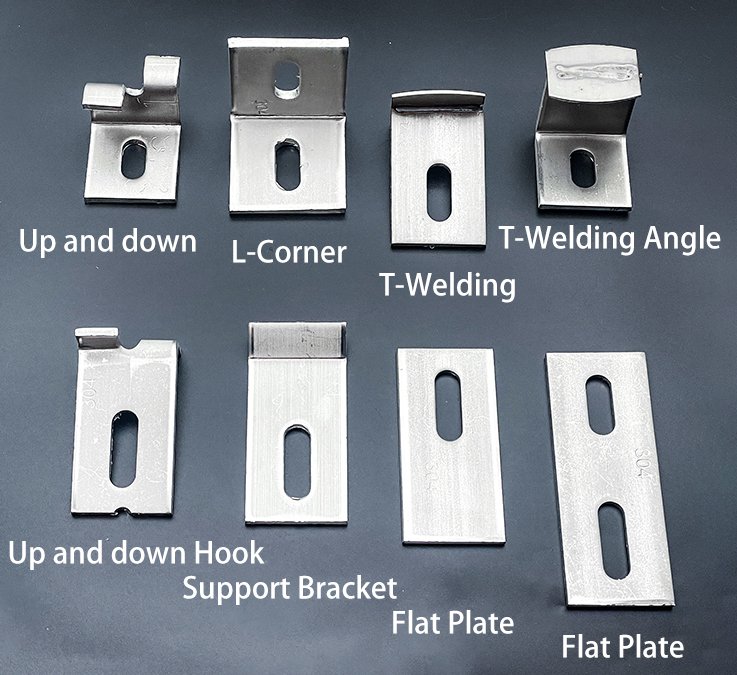
Depending on the panel design and supporting structure, different bracket systems can be used, including Up and Down Hook Brackets, Up and Down Hook Angle Brackets, T-Welding Brackets, T-Welding Angle Brackets and Stone Support Brackets.
Each fixing method has different requirements for the stone groove, supporting structure, adjustment range and installation conditions. Choosing the correct bracket helps achieve a stable, accurately aligned and practical stone cladding installation.
In this guide, we demonstrate the installation methods of different stone cladding brackets and compare their key characteristics, advantages and typical applications.
How to Choose the Right Stone Cladding Bracket
Up and Down Hook Bracket
A traditional double-hook fixing method for grooved stone panels. The bracket is mounted to a steel angle or subframe, while the upper and lower hooks engage with grooves prepared along the edges of the stone panel.
Best suited for: conventional stone facade systems with steel subframes.
Up and Down Hook Angle Bracket
A pre-formed version of the up-and-down bracket designed for direct wall fixing. It eliminates the need for a separate steel subframe in suitable applications.
Best suited for: direct wall-fixing projects where the wall substrate is properly prepared.
T-Welding Bracket
Uses a thin welded stainless steel plate instead of a formed hook. The thinner insertion plate can be advantageous for thinner stone and porcelain panels where a narrower groove is preferred.
Best suited for: stone, tile and porcelain panels where a welded insertion plate and grooved panel connection are required.
T-Welding Angle Bracket
Combines the thin welded plate of the T-Welding Bracket with a pre-formed angle body for direct wall installation.
Best suited for: thin panels where direct wall fixing and a compact installation system are required.
Stone Support Bracket
An auxiliary support component used mainly at the top and bottom of a facade, or wherever a conventional upper-and-lower fixing arrangement cannot be used on both sides of the stone panel.
Best suited for: facade terminations and additional bottom support.
Stainless Steel L-Corner Bracket
The Stainless Steel L-Corner Bracket is an auxiliary connecting component used to connect stone cladding brackets to a suitable wall or supporting substrate. It can provide additional positioning and adjustment space and, in suitable applications, reduce the need for a separate steel angle connection.
Stainless Steel Flat Plate Cladding Bracket
The Stainless Steel Flat Plate Cladding Bracket is an auxiliary spacer or extension plate used to provide additional distance, positioning or connection adjustment between the fixing point and the main stone cladding bracket.
| Bracket Type | Main Fixing Method | Supporting Structure | Typical Application | Main Advantage |
|---|---|---|---|---|
| Up and Down Hook | Upper & lower hook engagement | Usually steel angle/subframe | Natural stone | Traditional grooved stone fixing |
| Up and Down Hook Angle | Hook engagement | Direct fixing where suitable | Stone / tile | Pre-bent direct-fixing structure |
| T-Welding Bracket | Welded insertion plate | Usually steel angle/subframe | Stone / tile / porcelain | Compact groove engagement |
| T-Welding Angle | Welded insertion plate | Direct fixing where suitable | Stone / tile / porcelain | Compact direct-fixing structure |
| Stone Support Bracket | Angled support groove | Depends on system design | Natural stone | Top, bottom and termination support |
Frequently Asked Questions
How do I choose the right stone cladding bracket?
The bracket should be selected according to stone thickness, panel size, weight, groove design, cavity depth, supporting structure and adjustment requirements. The complete fixing system should be considered rather than choosing a bracket based only on size.
What is the difference between a standard bracket and an angle bracket?
Standard hook or T-welding brackets are commonly connected to a steel angle or supporting subframe, while angle versions have a pre-bent structure that can be fixed directly to a suitable wall or substrate where the project design allows.
Can stone cladding brackets be used for both natural stone and tile panels?
Different bracket types and thicknesses can be used for natural stone, ceramic tile and porcelain panels. The appropriate bracket configuration should be selected according to panel material, thickness, weight and groove design.
What are L-Corner and Flat Plate brackets used for?
L-Corner and Flat Plate brackets are auxiliary components used to provide connection, spacing, extension or positioning adjustment between the wall fixing point and the main stone cladding bracket.