
Cladding Clips
2-scaled-1.png)
From US $39 / 900 PIECE (EXW)
|
Specifications |
|
|
Item |
Availavble Options |
|
Material |
SS201 & SS304 & SS316 |
|
Thickness |
0.6mm & 0.8mm |
|
Sizes |
25*100 / 25*110 / 40*110 / 40*120mm |
|
Customization |
Custom sizes available |
|
Production |
Large-volume production available |
Stainless Steel Cladding Clip for Porcelain & Tile
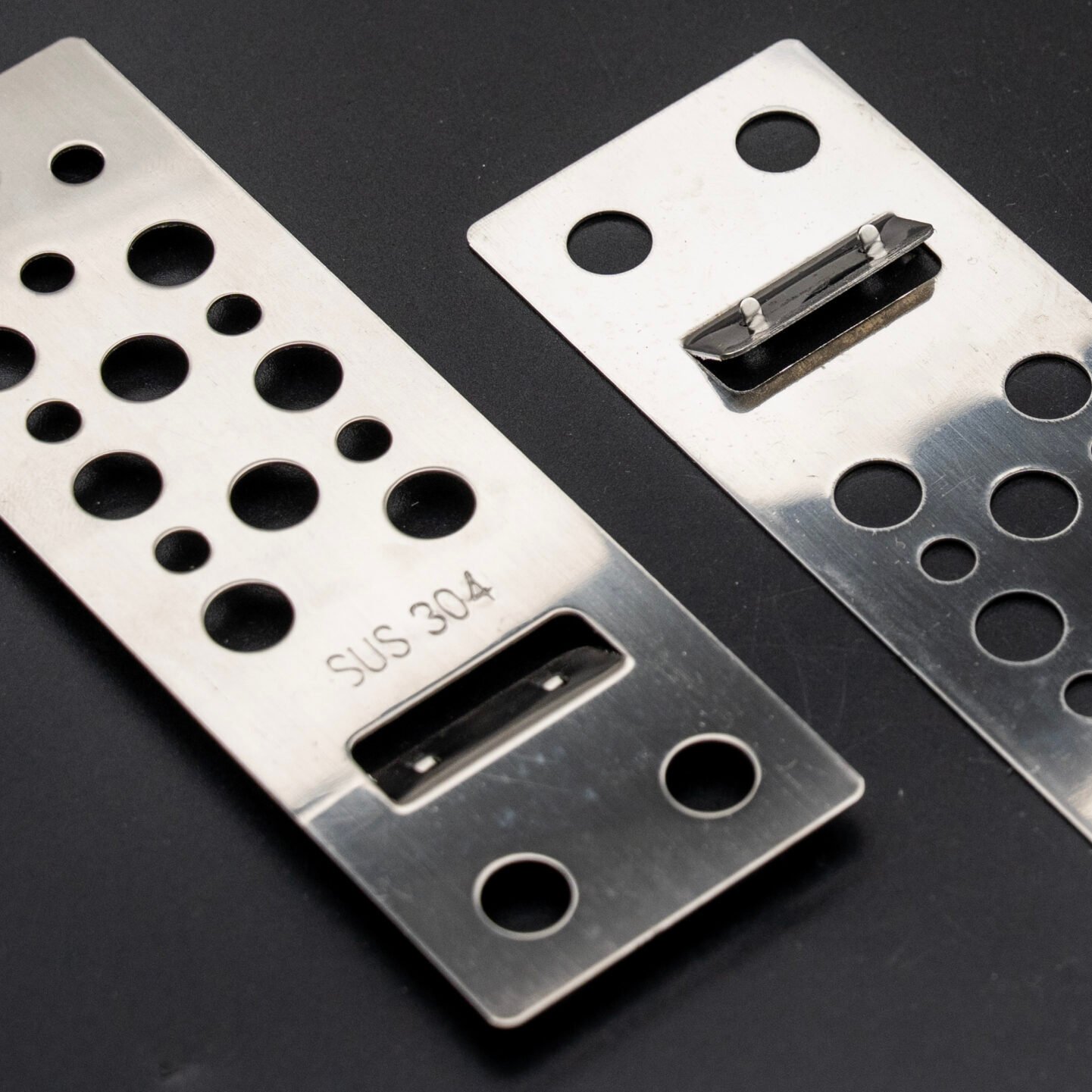
The Stainless Steel Cladding Clip for Porcelain & Tile is a secondary mechanical safety fixing designed for ceramic tiles, porcelain slabs and other thin cladding panels installed with adhesive.
The system adds a mechanical connection between the panel and the wall in addition to the tile adhesive, helping provide additional protection against panel detachment and improving the long-term reliability of the installation.
Similar stainless steel safety-hook systems are used internationally for ceramic and porcelain facade panels, where a concealed mechanical fixing supplements the adhesive bond.
How the Cladding Clip Works
The system is simple and designed to work together with conventional adhesive installation.
A pair of angled grooves is prepared near the upper rear edge of the porcelain slab or tile. Before inserting the clip, two-component epoxy adhesive (AB epoxy adhesive) can be applied into the grooves.
The angled insertion tab of the stainless steel clip is then inserted into the prepared grooves and further reinforced with epoxy adhesive.
After the epoxy has cured, the panel can be installed using the normal tile adhesive or slab adhesive system.
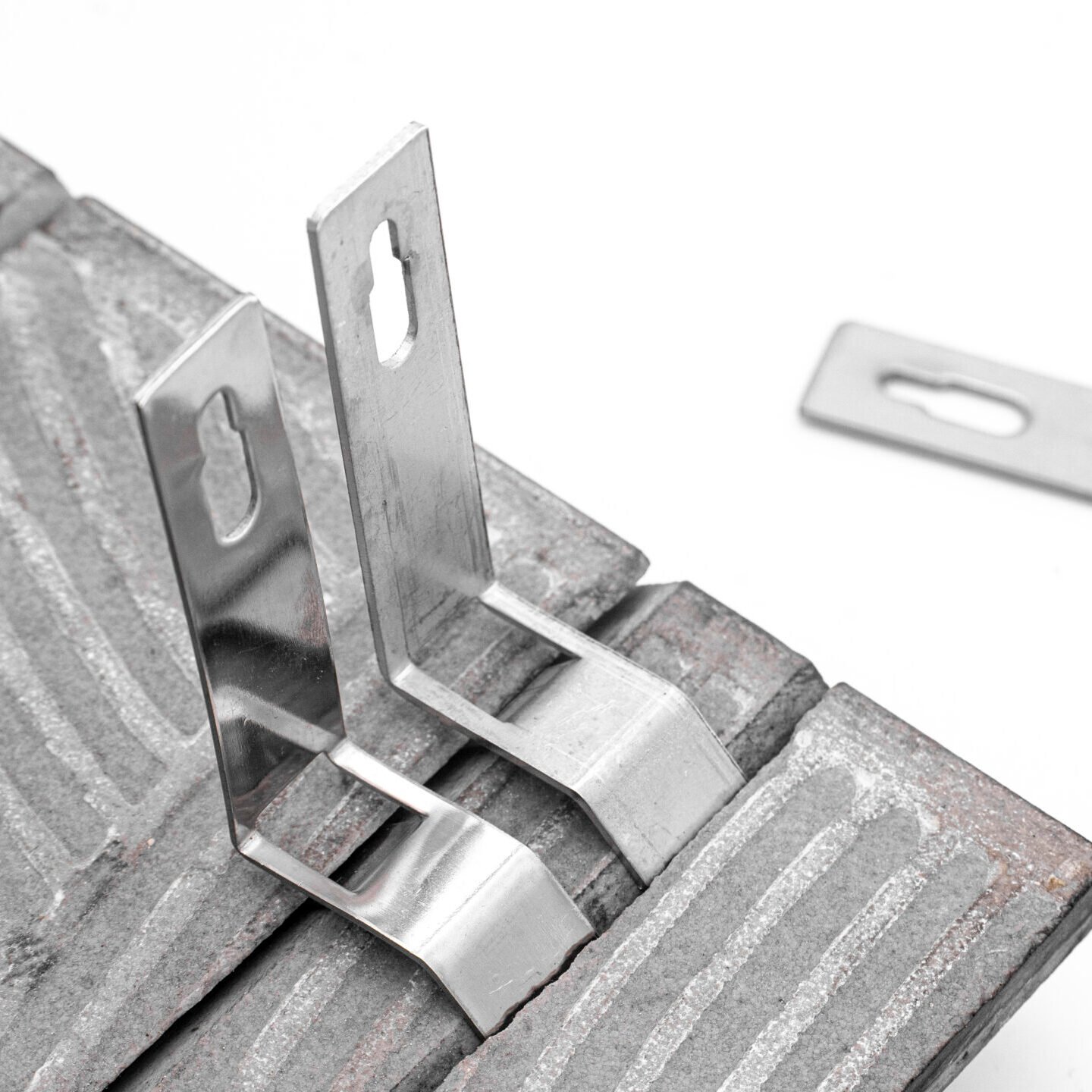
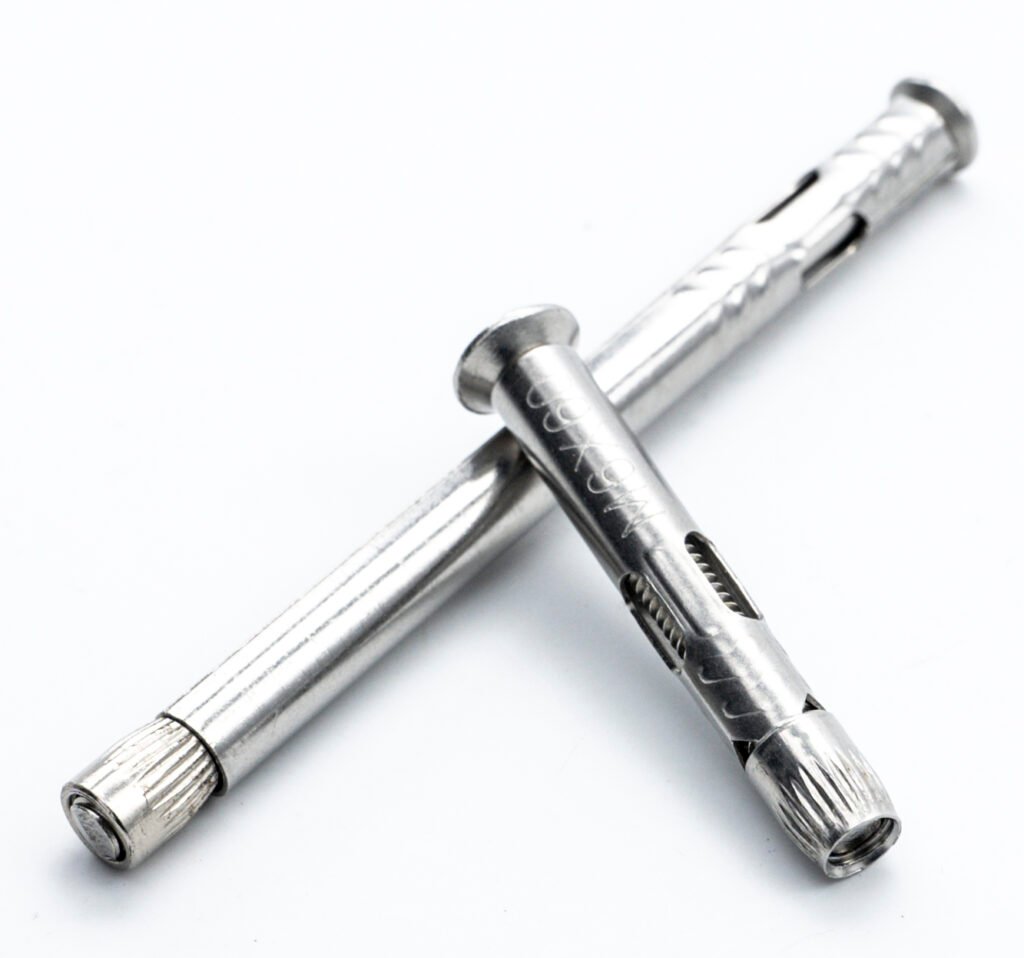
Once the panel is positioned on the wall, the exposed section of the clip is fixed to the wall using an appropriate mechanical anchor, commonly an M6 drop-in expansion anchor for suitable substrates.
This creates an additional mechanical connection between the panel and the wall, providing a secondary safety fixing in addition to the adhesive bond.
Secondary Mechanical Safety Fixing
Traditional ceramic and porcelain panel installation often relies primarily on adhesive bonding.
The Cladding Clip provides an additional mechanical retention point. If the adhesive bond is weakened by aging, environmental exposure or other factors, the mechanical clip can provide additional restraint against panel movement or detachment.
Comparable safety-hook systems in the market are specifically designed to supplement adhesive fixing and provide additional mechanical security for ceramic facade panels.
For exterior facade applications, the fixing configuration, anchor type and quantity should be selected according to the panel size, weight, substrate and project design requirements.
Straight and Bow-Shaped Versions
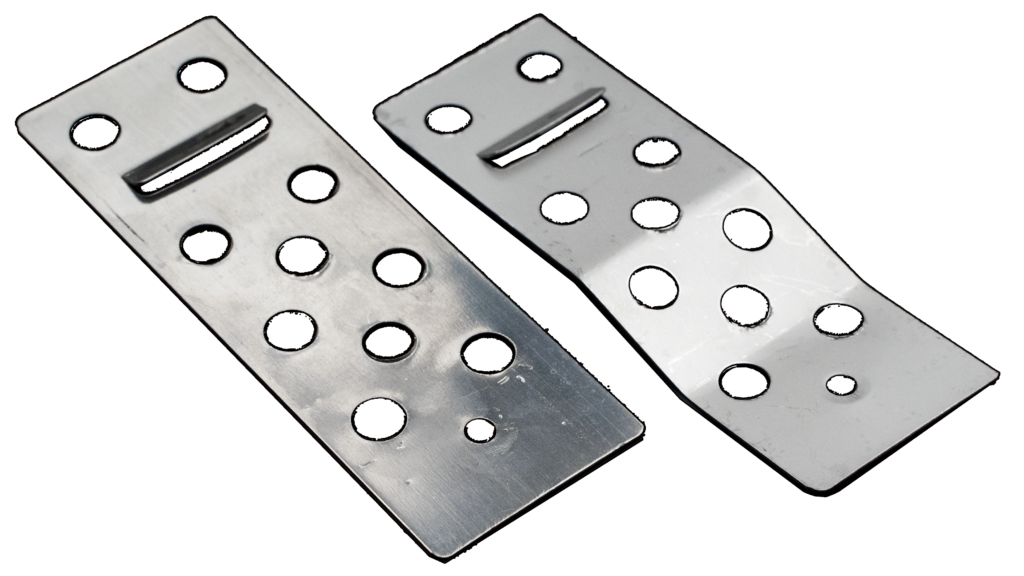
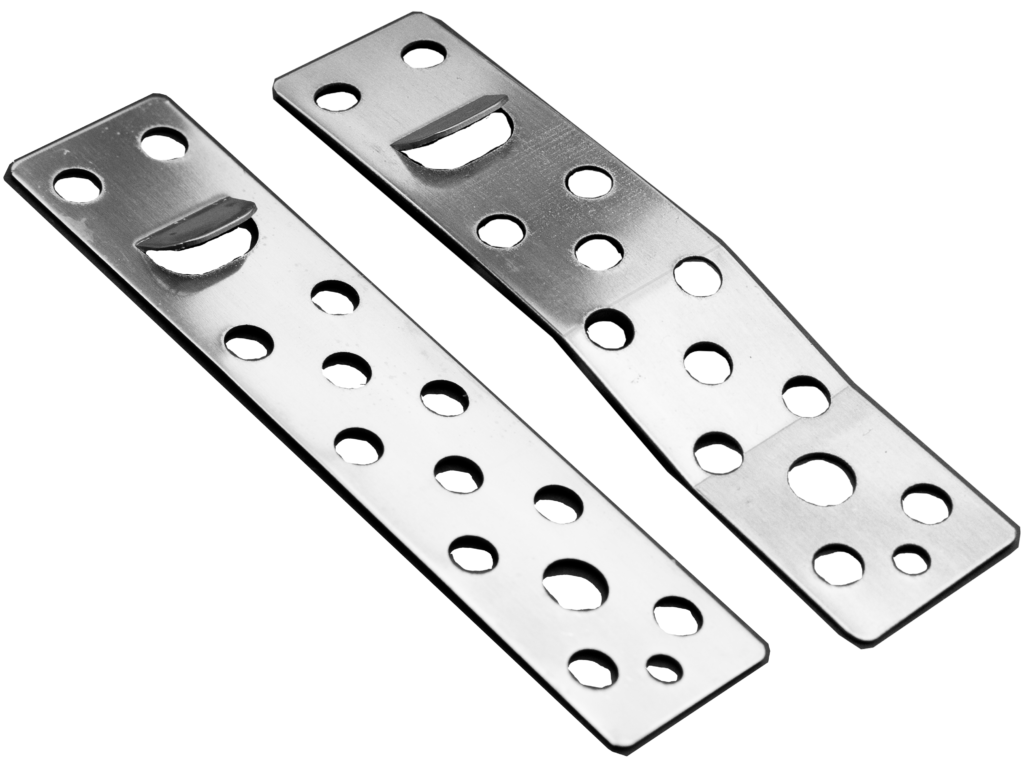
Our Cladding Clips are available in both straight and bow-shaped configurations.
The installation process is essentially the same for both versions.
When a straight clip is fixed to the wall after the panel is bonded, the clip may experience a small amount of deformation because the tile adhesive creates a gap between the back of the panel and the wall.
The bow-shaped version is pre-formed with a slight curved profile. This allows the clip to accommodate the installation geometry with less additional deformation after fixing, helping maintain a more stable mechanical connection.
The bow-shaped design can therefore be useful where maintaining the clip geometry during installation is important.
Designed for Thin Cladding Panels
The Cladding Clip is particularly suitable for:
- Porcelain slabs
- Ceramic tiles
- Thin stone panels
- Lightweight architectural cladding panels
The clip is installed near the upper rear section of the panel, leaving part of the clip body accessible for subsequent wall fixing.
Different clip dimensions and insertion-tab positions are available to suit different panel thicknesses and groove configurations.
Material and Standard Sizes
All of our current Cladding Clip versions are available in:
- Stainless Steel 201
- Stainless Steel 304
Stainless Steel 316 is available for customized production.
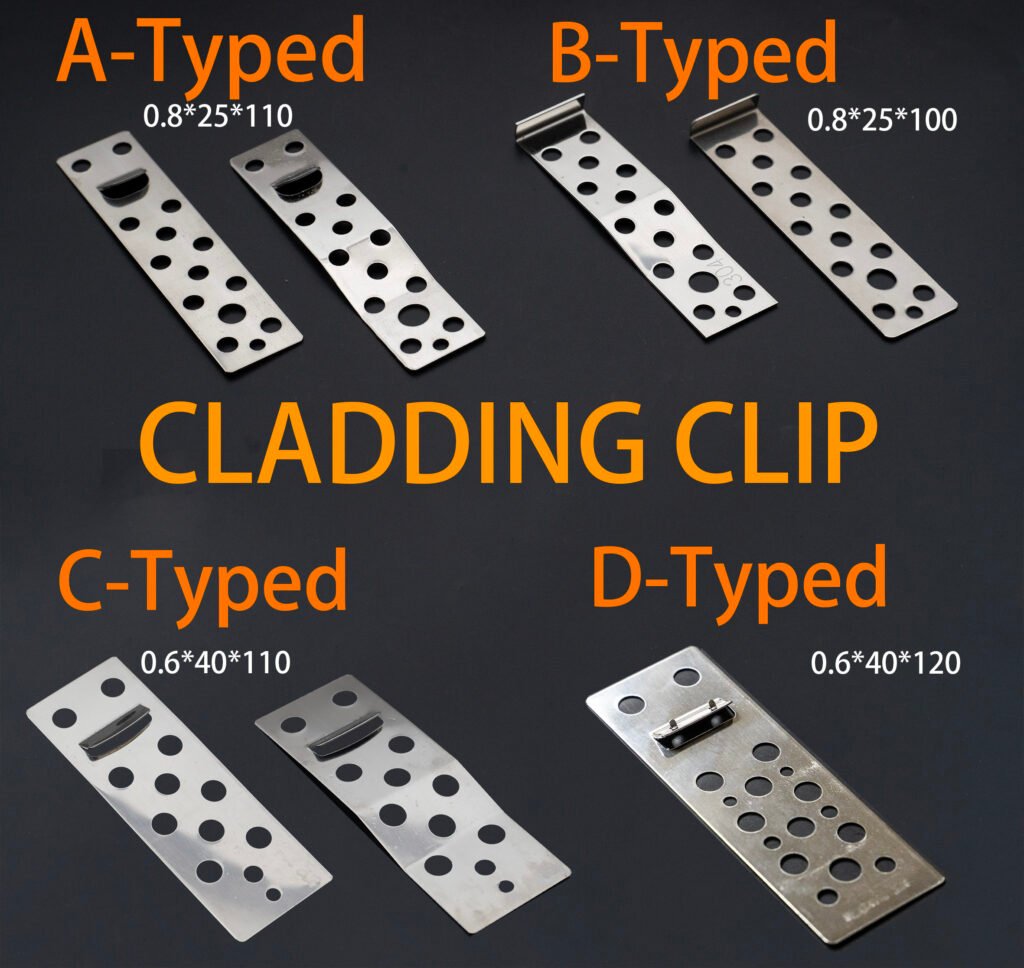
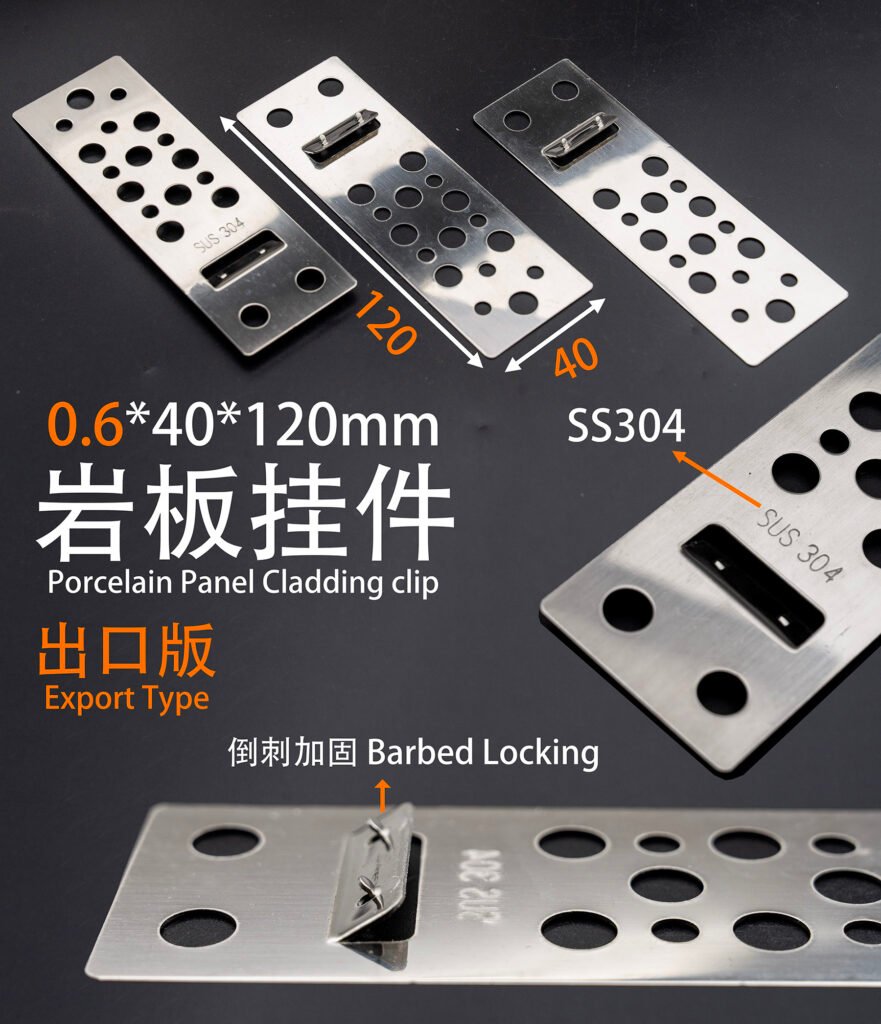
D-Type(Export Type)
- Thickness: 0.6 mm
- Width: 40 mm
- Length: 120 mm
The D-Type (Export Type) is a commonly used configuration for porcelain and ceramic cladding applications.
C-Type
- Thickness: 0.6 mm
- Width: 40 mm
- Length: 110 mm
A-Type
- Thickness: 0.8 mm
- Width: 25 mm
- Length: 110 mm
B-Type
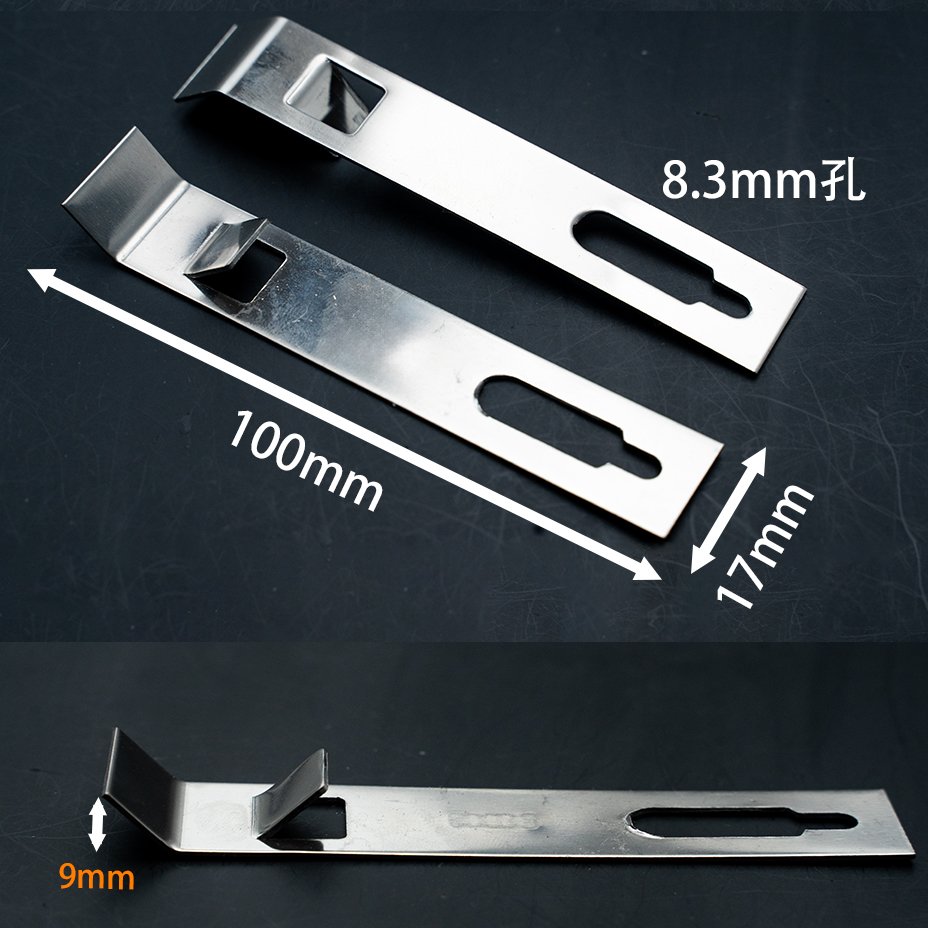
- Thickness: 0.8 mm
- Width: 25 mm
- Length: 100 mm
Except for the export version, the above configurations are also available in bow-shaped versions.
Key Features
- Secondary mechanical safety fixing
- Suitable for porcelain slabs and ceramic tiles
- Stainless steel 201 and 304 available from stock
- Stainless steel 316 available for custom production
- Straight and bow-shaped versions
- Multiple thicknesses and sizes
- Compatible with epoxy adhesive installation
- Designed for M6 mechanical wall anchors
- Additional protection against panel detachment
- Custom dimensions available
Typical Applications
The Stainless Steel Cladding Clip for Porcelain & Tile can be used for:
- Exterior porcelain slab facades
- Ceramic tile facades
- Interior tile wall systems
- Large-format porcelain panels
- Thin architectural cladding panels
- Adhesive-bonded cladding systems requiring additional mechanical safety fixing
International facade systems use stainless steel clips and concealed mechanical fixing components to provide additional restraint for ceramic and porcelain panels. Some systems use edge grooves and clips specifically to combine mechanical retention with adhesive installation.
Custom Manufacturing
We can customize the stainless steel grade, thickness, width, length, hole pattern, insertion-tab position and bow profile according to the panel thickness, groove dimensions and installation requirements.
For large-volume projects, customized Cladding Clips can be produced according to approved drawings or samples.
From US $36 / 3000 PIECE (EXW)
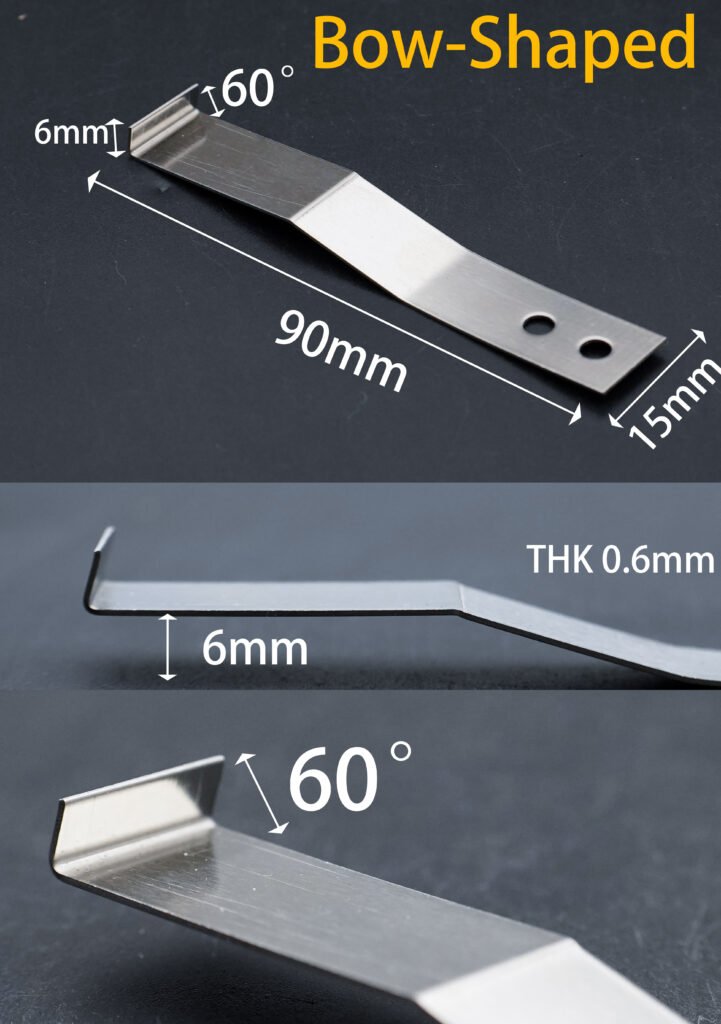
Stainless Steel Cladding Hook for Ceramic Tiles
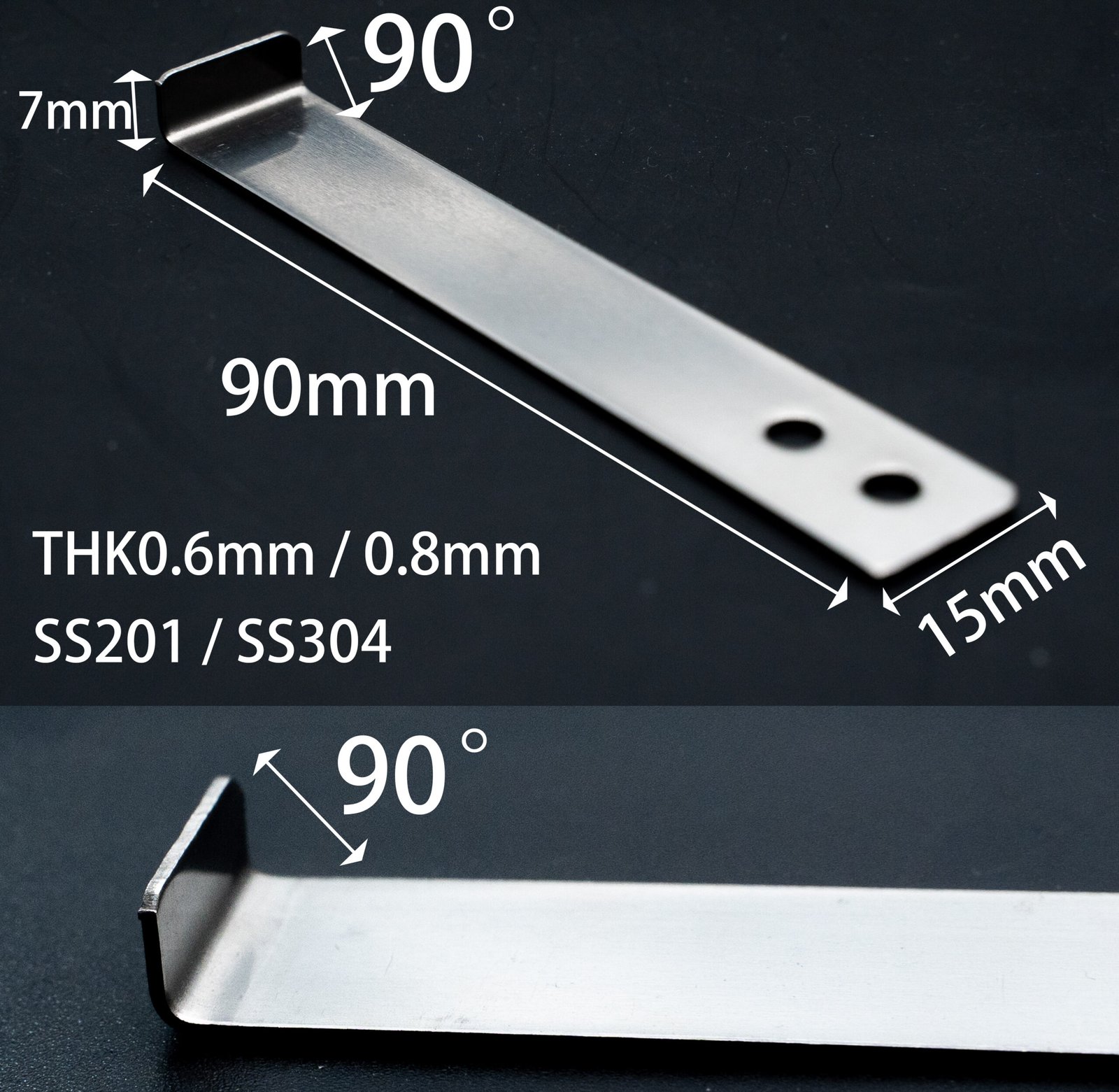
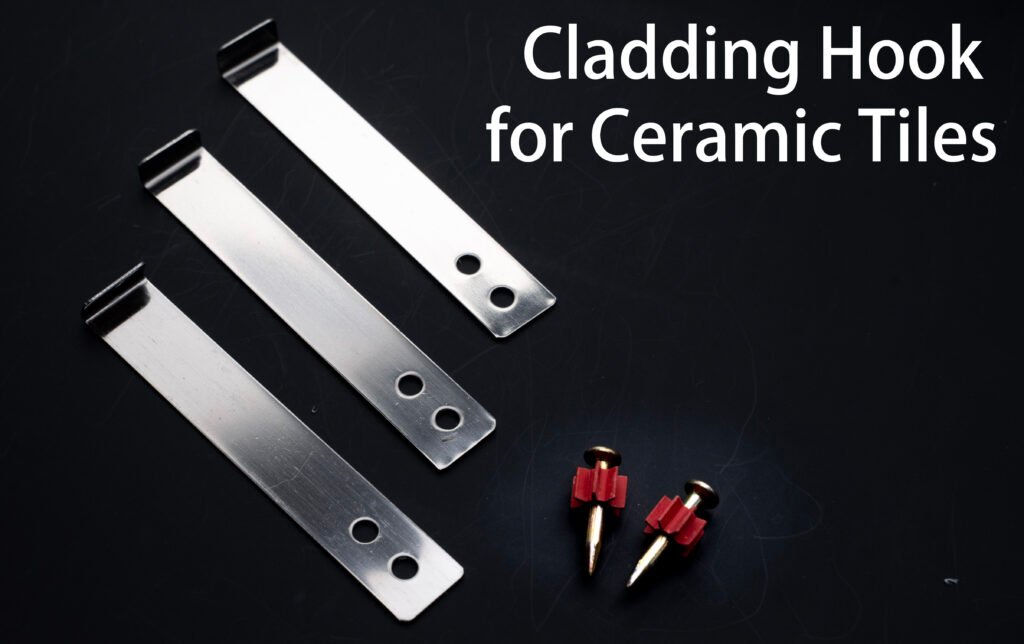
The Stainless Steel Cladding Hook for Ceramic Tiles is a compact mechanical safety fixing designed for ceramic tiles and other small-format cladding panels installed with adhesive. It works on the same principle as a porcelain slab Cladding Clip, adding a concealed mechanical connection between the tile and the wall to provide additional protection against panel detachment.
Because of its smaller size, the hook is particularly suitable for smaller and lighter tiles, offering a simple and cost-effective secondary fixing solution.
How the Cladding Hook Works
A groove is prepared on the rear of the tile near the upper edge. Depending on the hook configuration, the groove can be prepared as either a straight slot or an angled slot.
Before inserting the hook, two-component epoxy adhesive (AB epoxy adhesive) can be applied inside the groove. The hook is then inserted into the prepared groove and can be further reinforced with epoxy adhesive.
After the adhesive has cured, the tile can be installed using the normal tile adhesive system. Once the tile is positioned on the wall, the exposed part of the hook is mechanically fixed to the wall through its fixing hole.
This creates an additional mechanical safety connection alongside the tile adhesive. Similar concealed stainless steel safety hooks are widely used to supplement adhesive fixing for ceramic and porcelain facade panels.
60° and 90° Hook Options
Our Cladding Hooks are available in two main configurations:
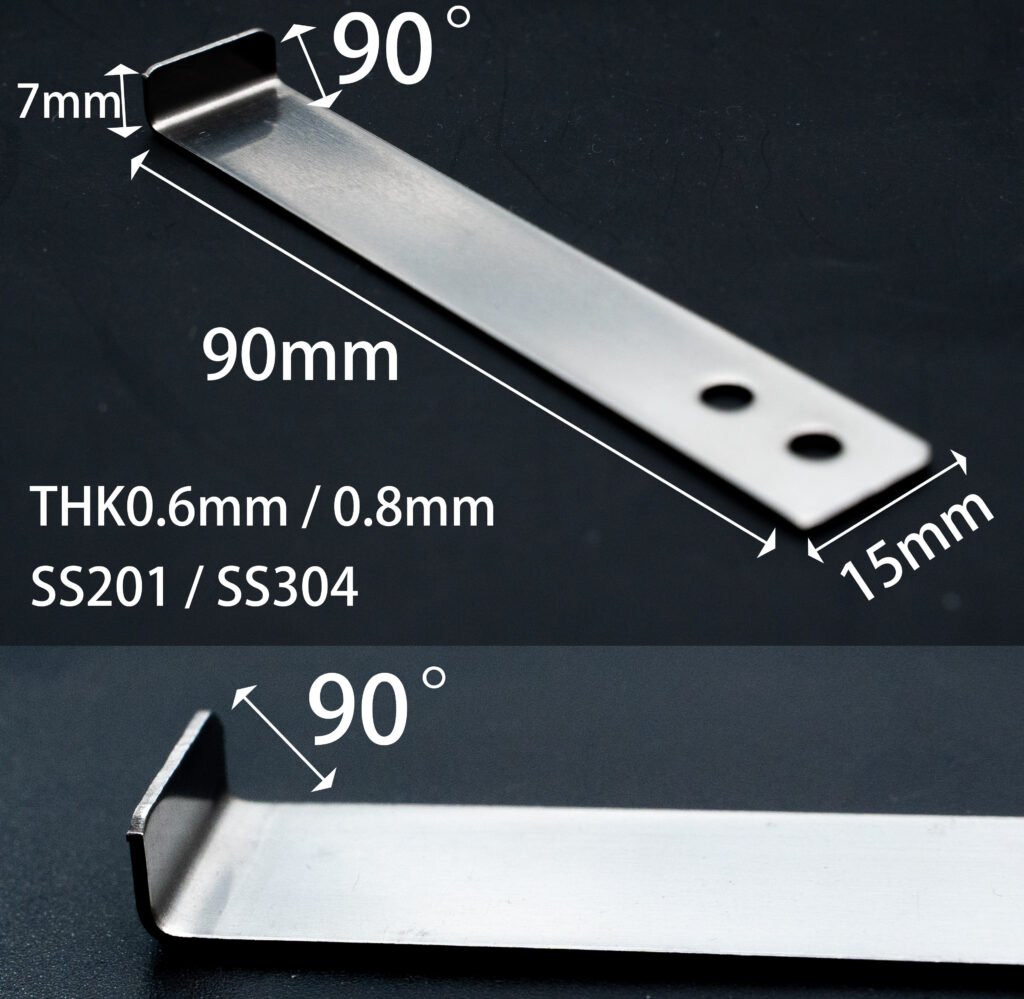
90° Hook
The fixing tab forms a right-angle profile and is installed into a corresponding 90° groove in the tile.
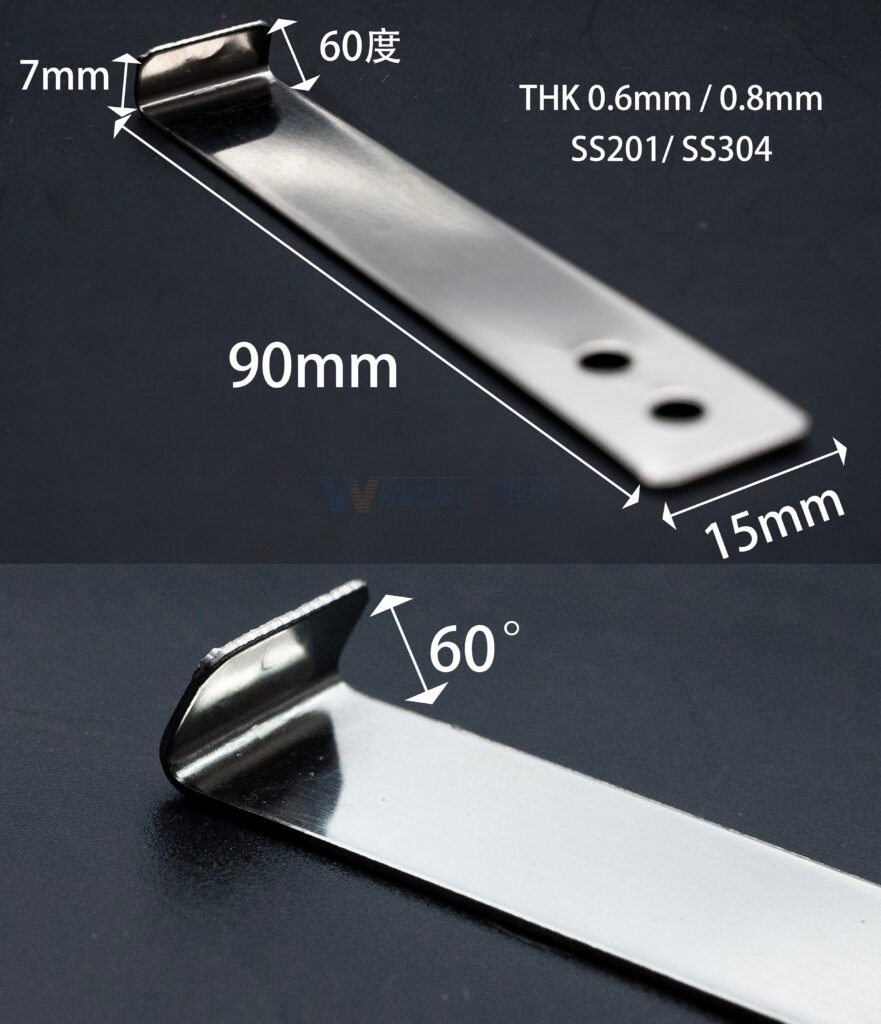
60° Hook
The fixing tab is formed at approximately 60 degrees and is inserted into an angled upward groove.
The two versions use the same basic fixing principle. The 60° version can be useful for thinner tiles where a deeper 90° groove may be more difficult to make safely.
Compact Design for Tile Applications
Compared with larger porcelain slab Cladding Clips, the Cladding Hook has a smaller overall profile and a smaller fixing hole.
This makes it suitable for smaller ceramic tiles and lightweight cladding panels, where a compact secondary fixing is preferred.
A small mechanical fastener such as an M3 drive pin / shooting nail can be used for wall fixing where compatible with the substrate and installation method.
Straight and Bow-Shaped Versions
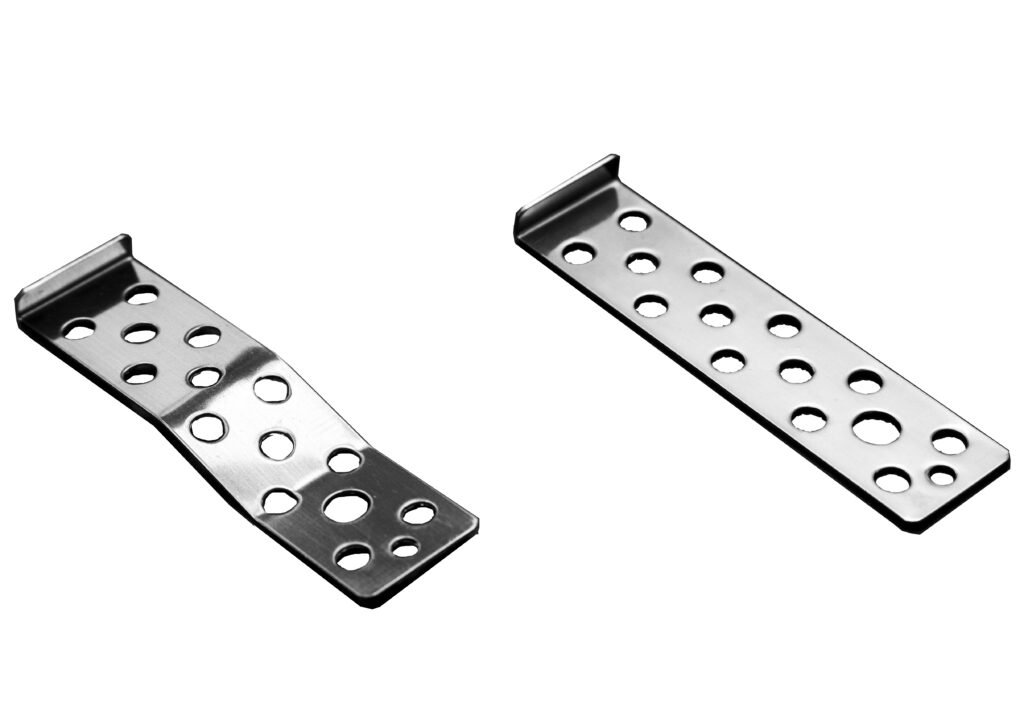
The 60° Cladding Hook is available in both straight and bow-shaped configurations.
The installation process is essentially the same.
The bow-shaped version is pre-formed with a slight curved profile, allowing it to better accommodate the adhesive layer between the tile and wall after mechanical fixing. This can help reduce additional deformation of the hook during installation and maintain a more stable connection.
Material and Standard Size
Our Cladding Hooks are available in:
- Stainless Steel 201
- Stainless Steel 304
Standard size:
- Thickness: 0.6 mm
- Width: 15 mm
- Length: 90 mm
Both 60° and 90° hook configurations are available.
Key Features
- Compact concealed mechanical safety fixing
- Designed for ceramic tiles and lightweight cladding
- 60° and 90° hook options
- Straight and bow-shaped versions
- Stainless Steel 201 and 304 available
- 0.6 × 15 × 90 mm standard size
- Suitable for adhesive-installed tile systems
- Additional protection against panel detachment
- Cost-effective solution for tile applications
- Custom sizes available
Typical Applications
The Stainless Steel Cladding Hook for Ceramic Tiles is suitable for:
- Ceramic tile facade systems
- Exterior wall tile installation
- Interior tile wall systems
- Small-format porcelain panels
- Lightweight architectural cladding
- Adhesive-installed tile systems requiring additional mechanical safety fixing
Similar stainless steel safety hooks are used internationally for ceramic and porcelain tiles to provide concealed mechanical restraint in addition to adhesive bonding.
From US $44 / 2000 PIECE (EXW)
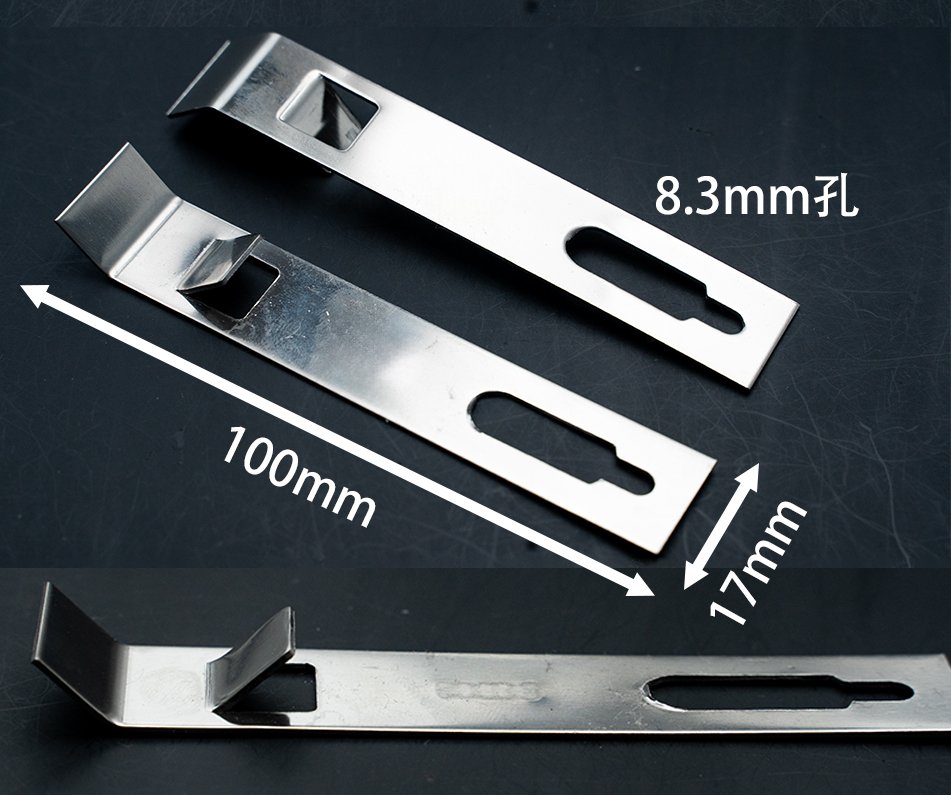
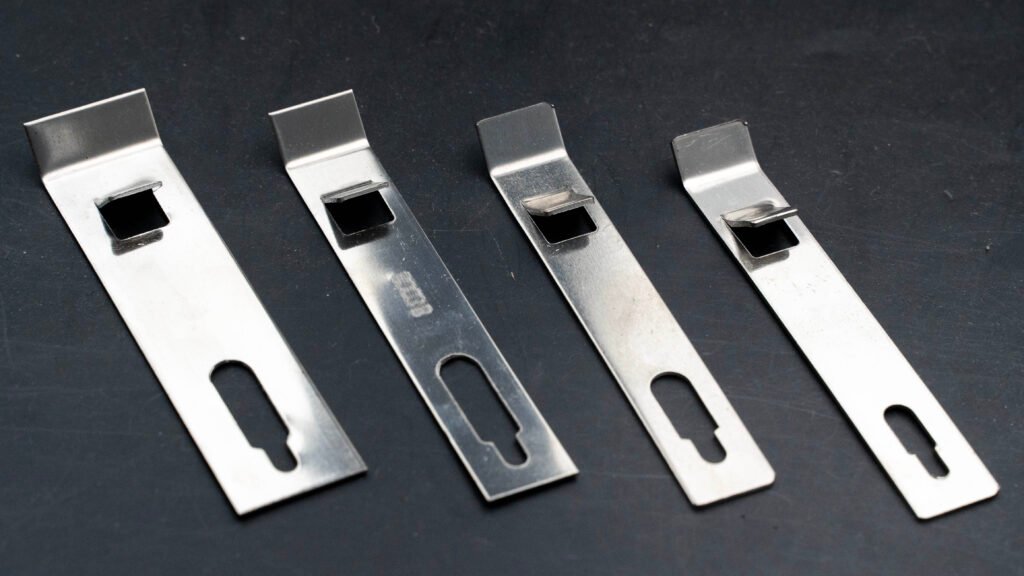
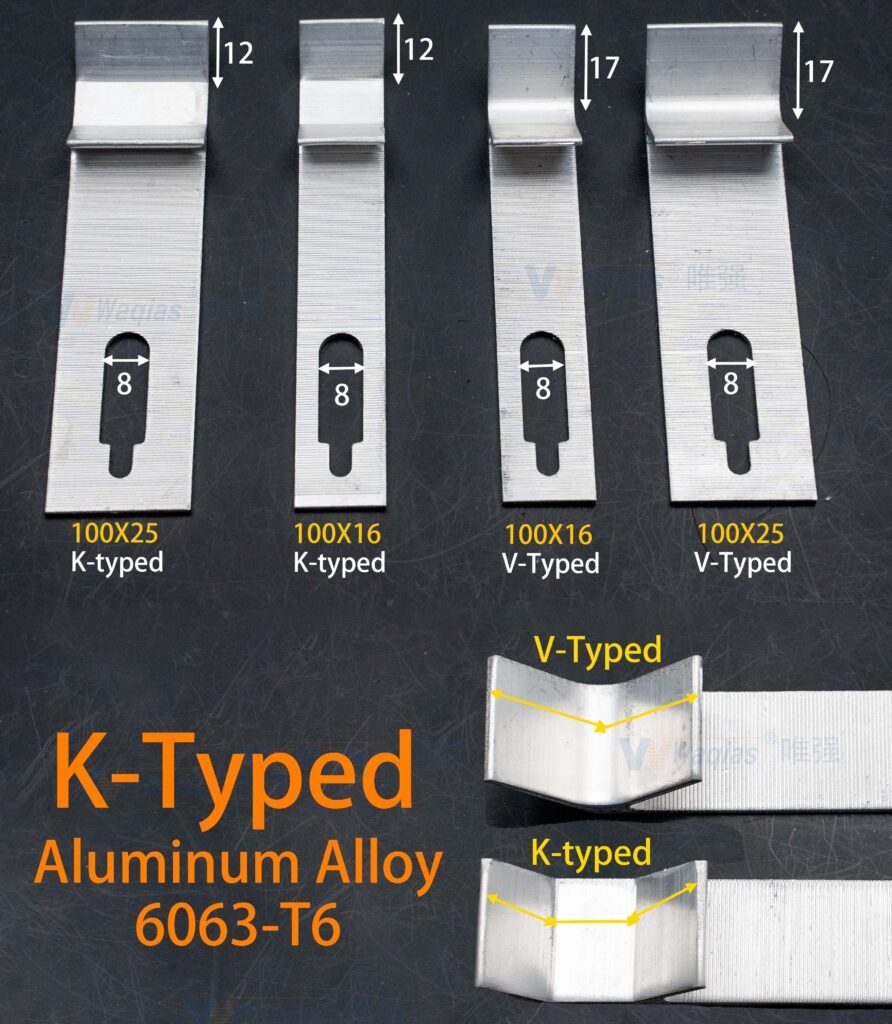
|
Specifications |
|
|
Item |
Availavble Options |
|
Material |
SS201 & SS304 & Aluminum Alloy |
|
Thickness |
0.8 / 0.9 / 1.0 / 1.2/ 1.6mm |
|
Sizes |
16*100 / 17*100 / 18*100 / 25*100mm |
|
Hook Depth |
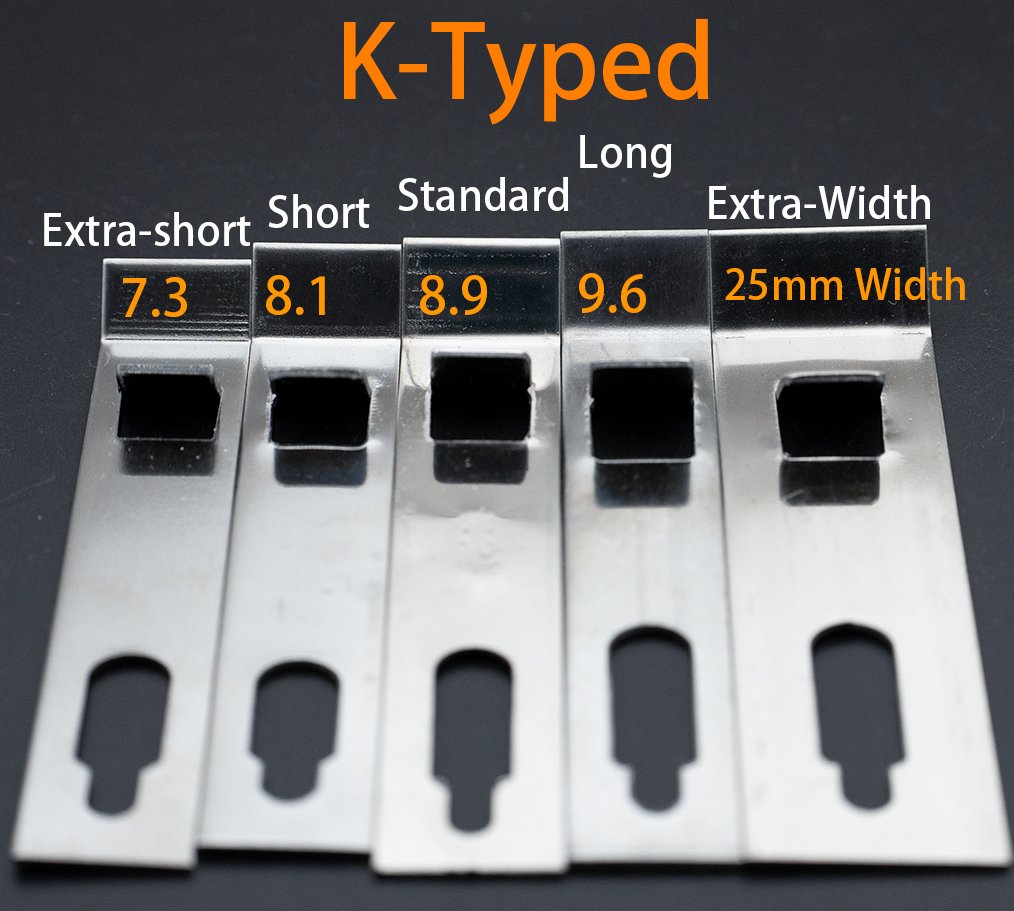
7.3 / 8.1 / 8.8 / 9.6 / 13mm |
|
Customization |
Custom sizes available |
|
Production |
Large-volume production available |
K-Type Cladding Clip
The K-Type Cladding Clip is a concealed mechanical fixing solution for ceramic tiles, porcelain slabs, sintered stone and other cladding panels. Unlike conventional cladding clips that rely mainly on adhesive reinforcement, the K-Type system uses a mechanically interlocking figure-eight groove to secure the clip inside the panel.
Its two hooked sections engage with the specially prepared groove, creating a strong mechanical connection before the panel is installed on the wall. This makes the K-Type Cladding Clip a practical solution when additional mechanical protection against panel detachment is required.
How the K-Type Cladding Clip Works
A long figure-“八-shaped” groove is prepared near the upper rear section of the tile or panel. (八 is the Chinese of eight)
The groove is formed from the sides of the panel and follows the profile required by the K-Type clip. The two hooks of the clip are then inserted into the corresponding groove and pushed into position from the side of the panel.
Once fully inserted, the two hooked sections mechanically engage with the groove, locking the clip into the panel.
The clip can remain mechanically engaged without adhesive, but two-component epoxy adhesive (AB epoxy adhesive) can also be applied to further secure the clip and reduce lateral movement inside the groove.
After the clip has been installed, the panel can be installed using the normal tile or panel adhesive system. Once the panel is fixed to the wall, the exposed fixing section of the K-Type clip is secured with an appropriate mechanical fastener, such as a drop-in expansion anchor or drive pin, depending on the substrate and installation method.
Mechanical Interlocking Design
The key difference between the K-Type Cladding Clip and conventional tile safety clips is its double-hook mechanical interlocking structure.
Traditional rear fixing clips typically use a single insertion tab and depend more heavily on epoxy adhesive to secure the clip inside a groove.
The K-Type clip uses two hooks that engage with the two sides of the figure-eight groove. This creates a mechanical lock between the clip and the panel, helping prevent the clip from being pulled directly out of the groove.
This mechanical interlocking structure makes the K-Type design particularly attractive for applications where secure panel retention is important.
Figure-Eight Groove Requirements
The main consideration when using the K-Type Cladding Clip is the preparation of the groove.
The figure-eight groove is longer and more precisely shaped than a conventional straight or angled groove. The groove must closely match the profile and dimensions of the K-Type clip so that the clip can slide into position and fully engage with the groove.
For this reason, precision groove cutting is important.
For production projects, we recommend having the panels processed by a professional stone or tile fabrication facility using the K-Type clip as the reference for groove dimensions. Machine cutting can provide more consistent groove geometry and production efficiency than manual cutting.
Designed for Thicker Thin-Panel Applications
Because the figure-eight groove requires a certain cutting depth, the K-Type Cladding Clip is generally more suitable for panels with sufficient thickness.
As a typical guideline, it is commonly used for panels around 8 mm and above, including:
- Ceramic tiles
- Porcelain slabs
- Sintered stone
- Thin natural stone
- Other architectural cladding panels
The exact suitable panel thickness depends on the groove dimensions, clip insertion depth and panel properties.
Hook Depth Options
The insertion depth of the K-Type clip is determined primarily by the hook length and hook angle.
We use a consistent hook angle and provide different hook lengths for different panel thicknesses and groove depths:
- 7.6 mm — Extra-short hook
- 8.1 mm — Short hook
- 8.9 mm — Standard hook
- 9.6 mm — Long hook
This allows the same basic K-Type concept to be adapted to different tile and panel thicknesses.
Material and Size Options
The K-Type Cladding Clip is available in:
- Stainless Steel 201
- Stainless Steel 304
- Aluminum Alloy 6063-T6
Stainless Steel 316 is available for customized production.
Thickness Options
- 0.8 mm
- 0.9 mm
- 1.0 mm
- 1.2 mm
- 1.6 mm (Aluminum Alloy 6063-T6)
Standard Body Size
The standard body size is approximately:
17 × 100 mm
For the standard and long-hook configurations, a wider version of:
25 × 100 mm
is also available.
Larger and thicker configurations generally provide greater material capacity and can be selected according to panel requirements.
Key Features
- Mechanical double-hook interlocking design
- Figure-eight groove fixing
- Additional protection against panel detachment
- Suitable for ceramic, porcelain and sintered stone panels
- 7.6–9.6 mm hook depth options
- Stainless Steel 201 / 304 and 6063-T6 aluminum options
- Straight and customized configurations available
- Suitable for machine-processed panel grooves
- Can be reinforced with AB epoxy adhesive
- Custom sizes available
Typical Applications
The K-Type Cladding Clip is suitable for:
- Ceramic tile wall cladding
- Porcelain slab installation
- Sintered stone cladding
- Thin stone panels
- Interior and exterior architectural wall systems
A K-Type ceramic/porcelain cladding bracket is also marketed internationally for ceramic tile, porcelain tile and sintered stone applications, with different sizes available for different panel thicknesses.
Custom Manufacturing
We can customize the material, thickness, body width, body length, hook length, hook configuration and overall dimensions according to the panel thickness, groove geometry and installation requirements.
For large-volume projects, we can also produce K-Type Cladding Clips according to approved drawings or samples.
From US $76 / 2000 PIECE (EXW)
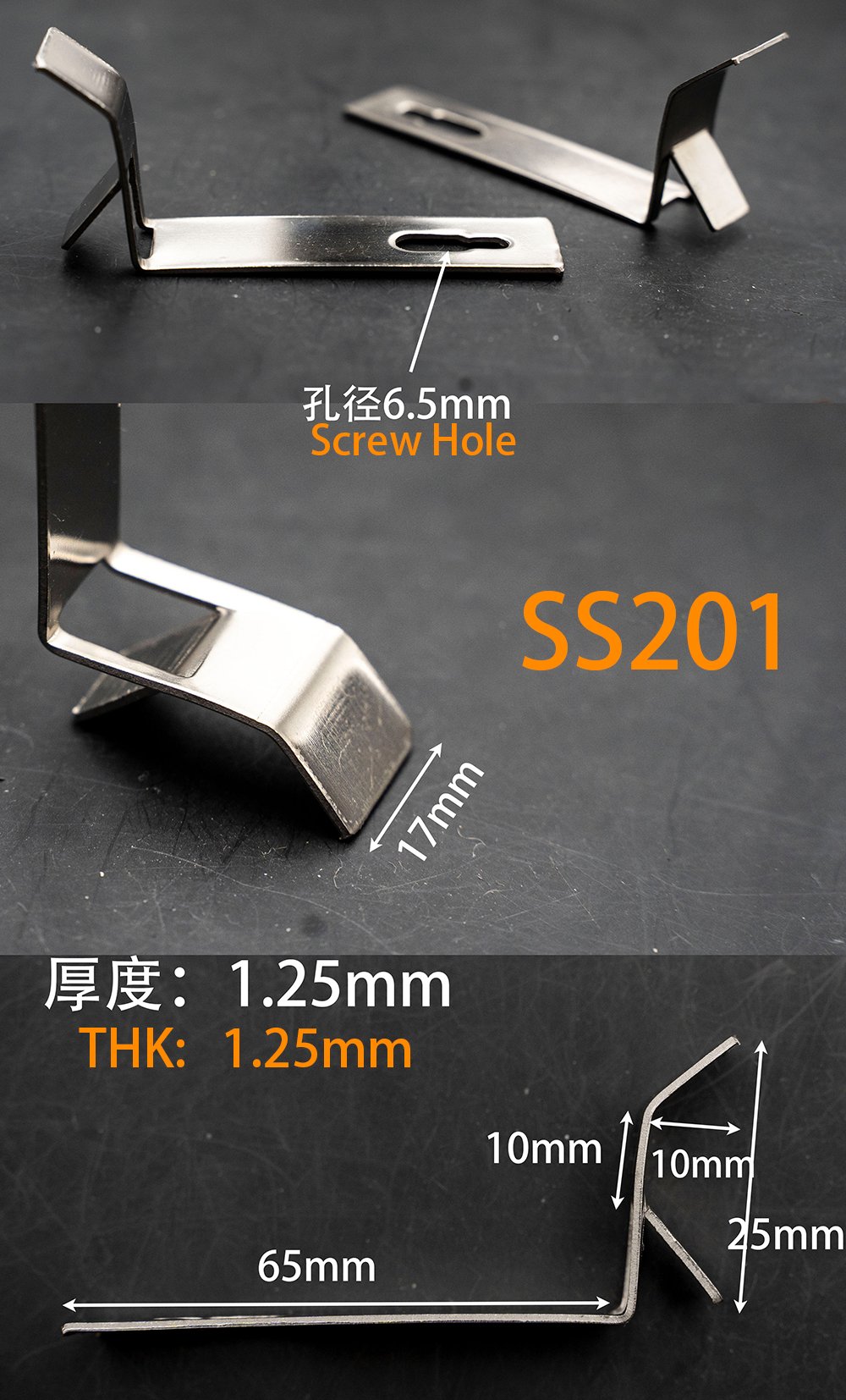
K-Type Bottom-Mount Tile Cladding Clip
The K-Type Bottom-Mount Tile Cladding Clip is a bent K-type mechanical fixing clip designed for ceramic tiles, porcelain slabs and other thin cladding panels installed beneath a horizontal beam or crossbeam.
Like the standard K-Type Cladding Clip, it uses a figure-eight groove prepared in the rear of the panel. The two hooked sections engage with the groove to create a mechanical interlocking connection. The bent body of the clip then allows the fixing point to be positioned on the underside of the supporting beam.
Bottom-Mount Installation
After the figure-eight groove is prepared, the K-Type clip is inserted from the side of the panel and positioned at the required location. Once the panel is installed, the bent section of the clip is secured to the underside of the horizontal beam using an appropriate mechanical fastener.
The groove position is important for this installation method. The distance between the groove and the upper and lower edges of the panel must be accurately designed:
- Groove too close to the edge: the clip may interfere with or contact the beam.
- Groove too far from the edge: a gap may remain between the clip and the beam, affecting the intended fixing position.
For this reason, accurate groove positioning and fabrication are particularly important when using the Bottom-Mount K-Type Clip.
Typical Applications
This clip is mainly used for tile or porcelain panels installed beneath horizontal beams, crossbeams or similar overhead structures. Because horizontal beam applications are relatively limited, it is a more specialized K-Type fixing solution.
Key Features
Customized dimensions available
Bent K-Type mechanical fixing design
Figure-eight groove interlocking
Bottom-mount installation
Suitable for tile and porcelain panels
Designed for horizontal beam applications
Requires precise groove positioning
From US $43 / 500 PIECE (EXW)
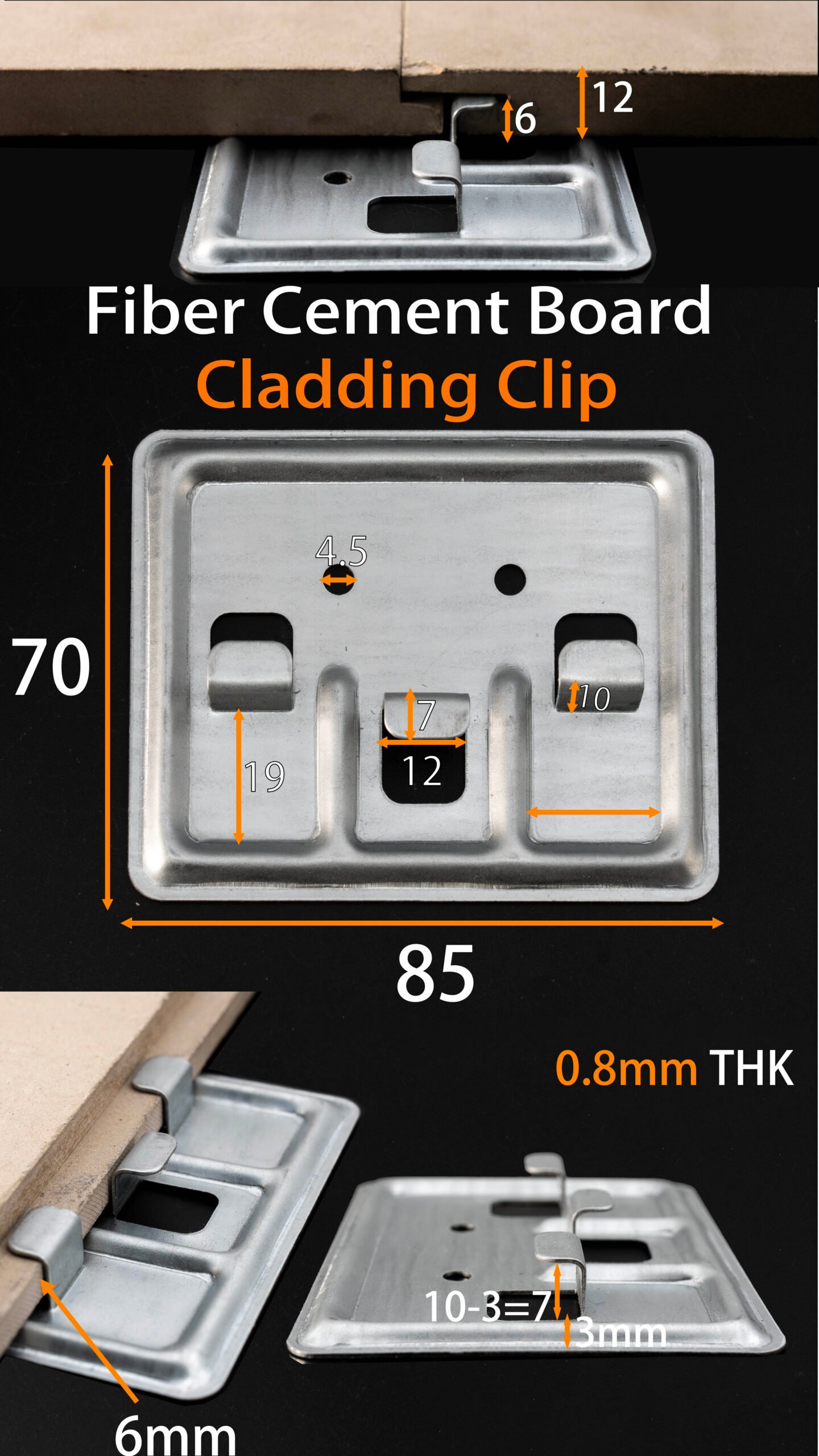
Fiber Cement Board Cladding Clip
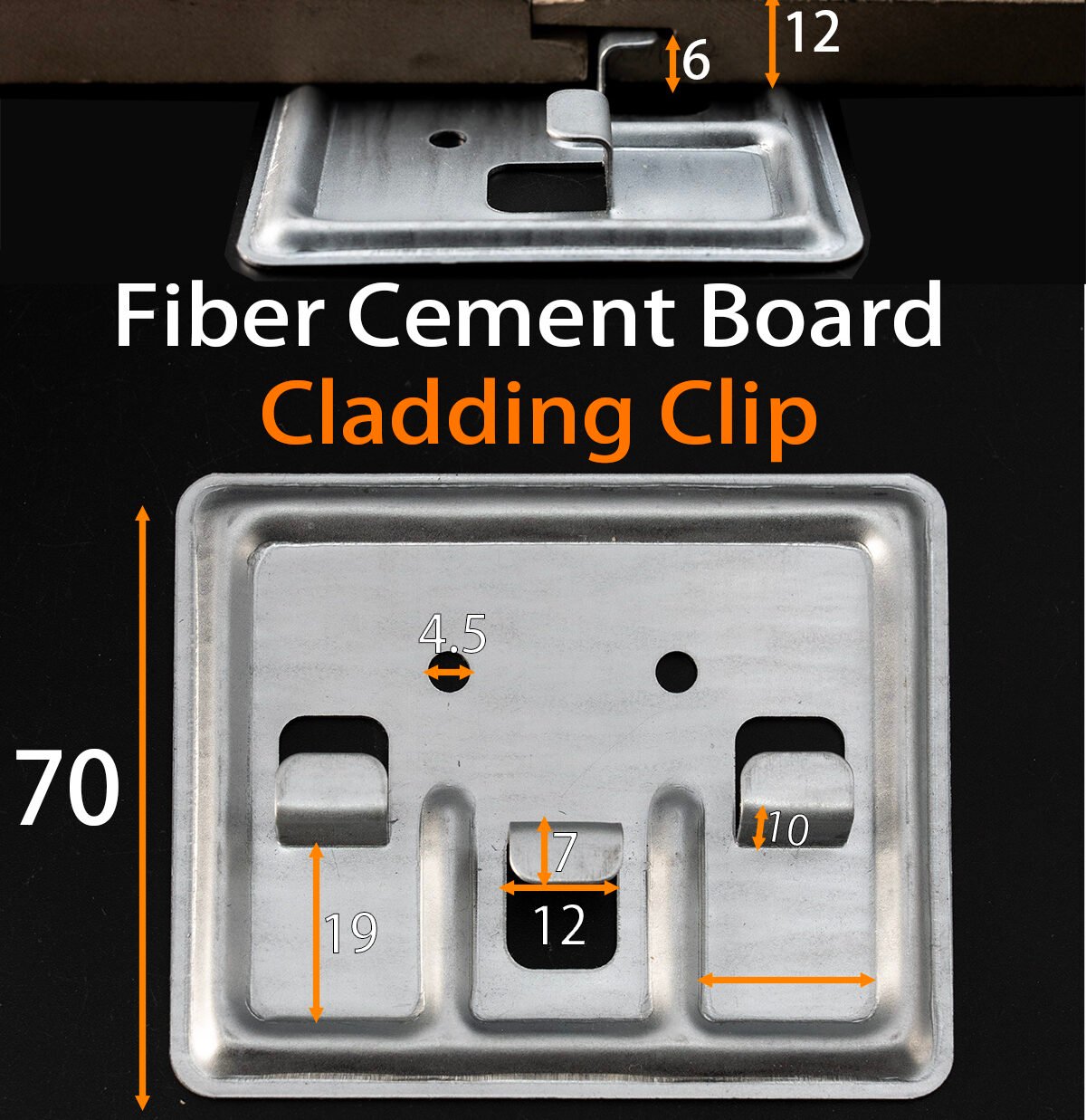
The Fiber Cement Board Cladding Clip is a concealed mechanical fixing component designed specifically for fiber cement facade panels. It is used with fiber cement boards featuring pre-formed edge grooves, allowing the panel to engage directly with the clip for a close and secure connection.
Unlike general-purpose cladding clips that require grooves to be machined into the panel during installation, this system is designed to match the factory-formed groove profile of the fiber cement board.
How the Fiber Cement Board Cladding Clip Works
The fiber cement panel is manufactured with a matching groove along its upper or lower edge.
The clip is fixed to a vertical metal subframe or supporting column using suitable screws. The raised hook section of the clip then engages with the groove in the fiber cement panel.
The matched groove-and-clip profile allows the panel to sit closely against the fixing component, helping achieve a small and consistent joint between adjacent panels when the system is properly designed and installed.
This type of concealed clip fixing is consistent with how fiber cement panel clip systems are specified in architectural facade assemblies.
Designed for Factory-Grooved Fiber Cement Panels
The key feature of this clip is its compatibility with the pre-formed panel groove.
The current configuration is designed for fiber cement boards with an approximately 6 mm groove. The clip hook engages with the groove to provide a concealed mechanical connection between the panel and vertical supporting structure.
Because the groove is formed during panel production, the clip does not require the same type of on-site groove machining used by products such as K-Type Cladding Clips.
Material and Standard Specification
This product is currently available in:
- Hot-Dip Galvanized Steel
- Thickness: 0.8 mm
- Overall size: 70 × 85 mm
- Suitable groove: 6 mm
The current product is a customized specification developed for a specific fiber cement board application.
Custom Manufacturing
Different materials, thicknesses, dimensions, hook profiles and groove configurations can be customized according to the fiber cement panel manufacturer’s requirements.
We can develop the clip based on an existing panel sample, groove drawing or approved technical dimensions.
Key Features
- Designed specifically for fiber cement board
- Concealed panel fixing
- Compatible with pre-formed panel grooves
- Close and stable panel engagement
- Fixed to vertical metal subframes or structural columns
- Current configuration for approximately 6 mm grooves
- Hot-dip galvanized steel
- Custom sizes and profiles available
Typical Applications
The Fiber Cement Board Cladding Clip is suitable for:
Panel systems installed on vertical metal subframespe Cladding Clips according to approved drawings or samples.
Fiber cement facade panels
Fiber cement board wall cladding
Exterior ventilated facade systems
Interior fiber cement wall panels
From US $93 / 1500 PIECE (EXW)
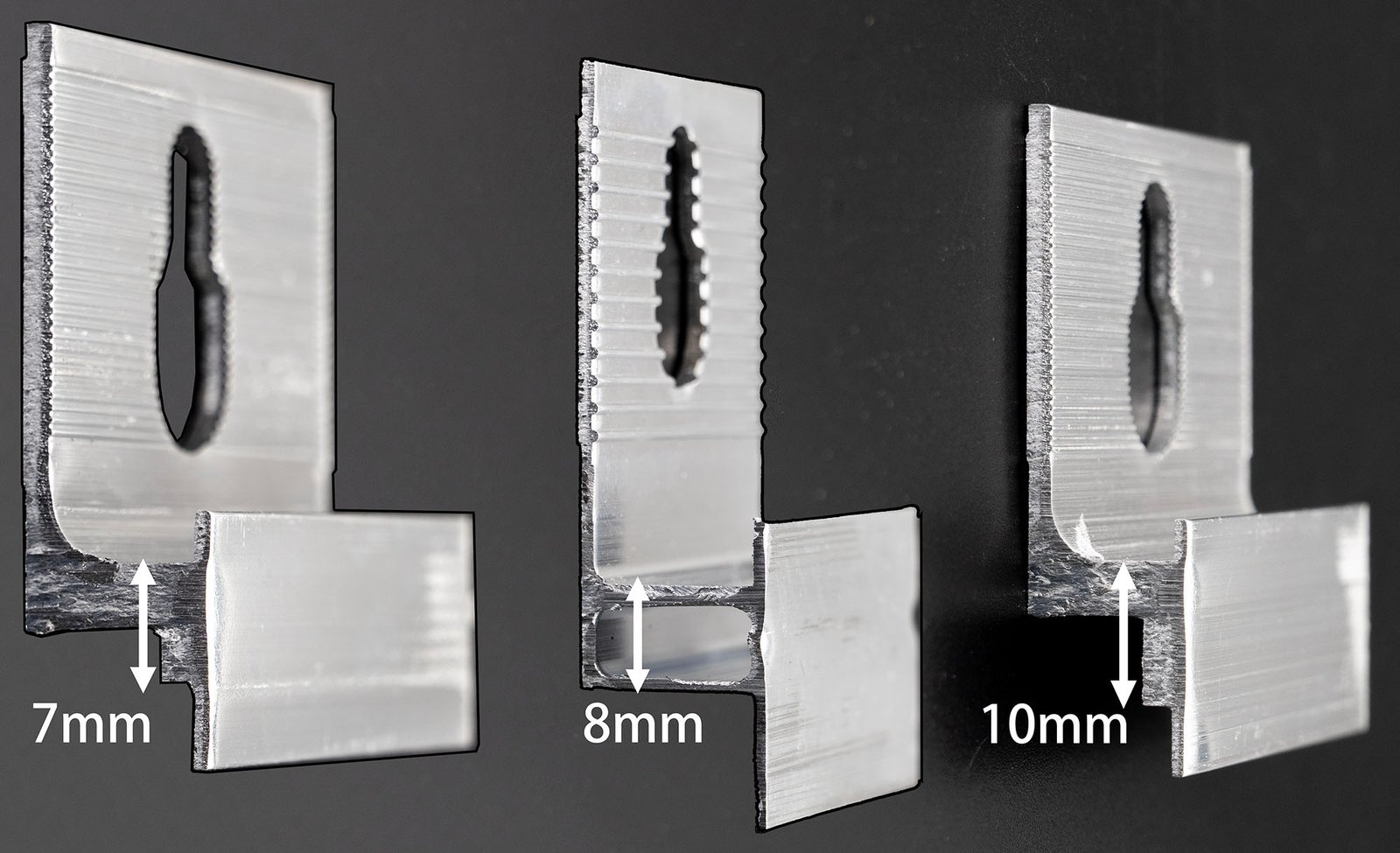
|
Specifications |
|
|
Item |
Availavble Options |
|
Material |
Aluminum Alloy |
|
Thickness |
1.6mm / 1.8mm |
|
Sizes |
38*35 / 38*41mm |
|
Fixed-Gap |
7.0 / 8.0 / 10.0mm |
|
Customization |
Custom sizes available |
|
Production |
Large-volume production available |
L-Type Aluminum Alloy Cladding Clip
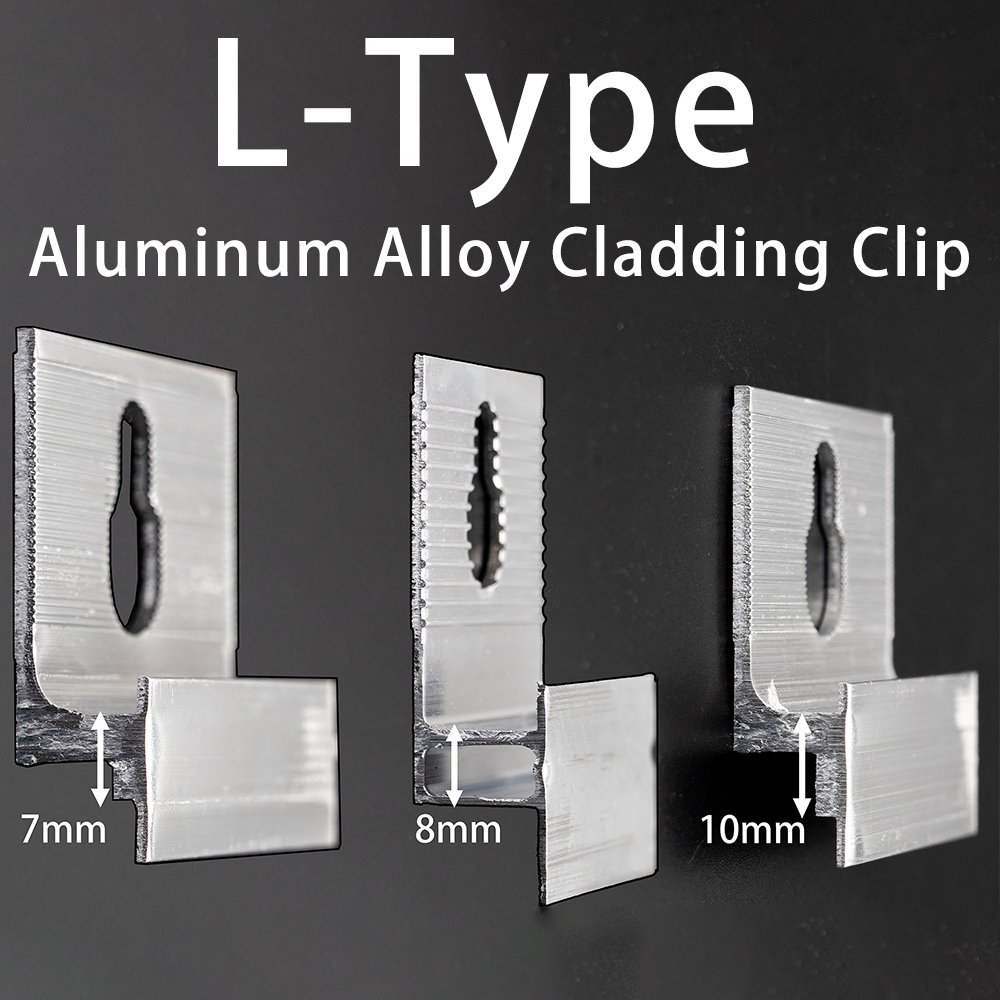
The L-Type Aluminum Alloy Cladding Clip is a fixed-gap mechanical fixing component designed for exterior ceramic tiles, porcelain tiles and other architectural cladding panels. Its integrated L-shaped profile provides both panel support and a consistent joint width between adjacent panels.
Compared with a conventional T-Welding Angle Bracket, the L-Type Cladding Clip has a specially designed spacer section that controls the gap between the upper and lower panels, helping installers achieve a more uniform and visually consistent facade.
Fixed-Gap Design
The key feature of the L-Type Cladding Clip is its integrated fixed-gap structure.
Unlike a conventional angle bracket, where the joint width is largely determined by the thickness of the bracket itself, the L-Type Cladding Clip uses a dedicated spacer profile to maintain a predetermined gap.
Three standard configurations are available:
- 7 mm gap
- 8 mm gap
- 10 mm gap
The 7 mm and 10 mm versions use a raised support section to establish the required gap.
The 8 mm version uses a full 8 mm spacer profile with a central cut-out. The opening reduces material consumption while maintaining the required structural profile.
How the L-Type Cladding Clip Works
The thin fixing plate of the clip is inserted into a prepared groove in the rear of the tile or cladding panel.
The bracket is then fixed to the supporting structure using the appropriate mechanical fastener. The integrated spacer section remains between adjacent panels and establishes the designed joint width.
This allows the installer to maintain a consistent gap during installation without relying solely on manual positioning.
The fixing plate is 1.1 mm thick, while the main L-type body is 1.8 mm thick.
Designed for Exterior Tile Cladding
The L-Type Cladding Clip is particularly suitable for exterior ceramic tiles, porcelain tiles and quartz-based facade tiles, where maintaining a controlled joint can be important.
Exterior cladding is exposed to temperature changes and structural movement. Properly designed joints help accommodate thermal and other movements and reduce the risk of stress being transferred to the tile system. Movement-joint guidance for ceramic tile facades specifically emphasizes the need to account for temperature-induced expansion and contraction.
The fixed-gap design of the L-Type Cladding Clip helps maintain a consistent visual joint while providing a defined space between adjacent panels.
Important: The clip itself does not replace a properly designed movement-joint system. Joint width and movement-joint locations should still be determined according to the panel system, substrate and project requirements.
Material and Size Options
The L-Type Cladding Clip is manufactured from aluminum alloy.
Standard Specifications
- Main body thickness: 1.8 mm
- Insertion plate thickness: 1.1 mm
- Available joint widths: 7 mm, 8 mm and 10 mm
The three configurations are designed for different facade joint requirements.
Custom dimensions can be developed according to panel thickness, groove dimensions, required joint width and installation conditions.
Key Features
- Fixed-gap cladding clip design
- 7 mm, 8 mm and 10 mm joint options
- 1.8 mm aluminum alloy main body
- 1.1 mm insertion plate
- Suitable for exterior tile and porcelain cladding
- Helps maintain consistent panel joints
- Lightweight aluminum construction
- Central cut-out option for material efficiency
- Custom dimensions available
Typical Applications
The L-Type Aluminum Alloy Cladding Clip is suitable for:
- Exterior ceramic tile facades
- Porcelain tile cladding
- Quartz tile / quartz-based facade panels
- Architectural wall cladding
- Ventilated or mechanically fixed tile facade systems
Mechanical clip systems are widely used for ceramic and porcelain facade panels, with clip arrangements allowing controlled joints and accommodating movement within the facade system.
From US $103 / 2000 PIECE (EXW)
|
Specifications |
|
|
Item |
Availavble Options |
|
Material |
Aluminum Alloy |
|
Thickness |
1.7-1.8mm |
|
Sizes |
38*35 / 38*41mm |
|
Fixed-Gap |
7.0 / 8.0 / 10.0mm |
|
Customization |
Custom sizes available |
|
Production |
Large-volume production available |
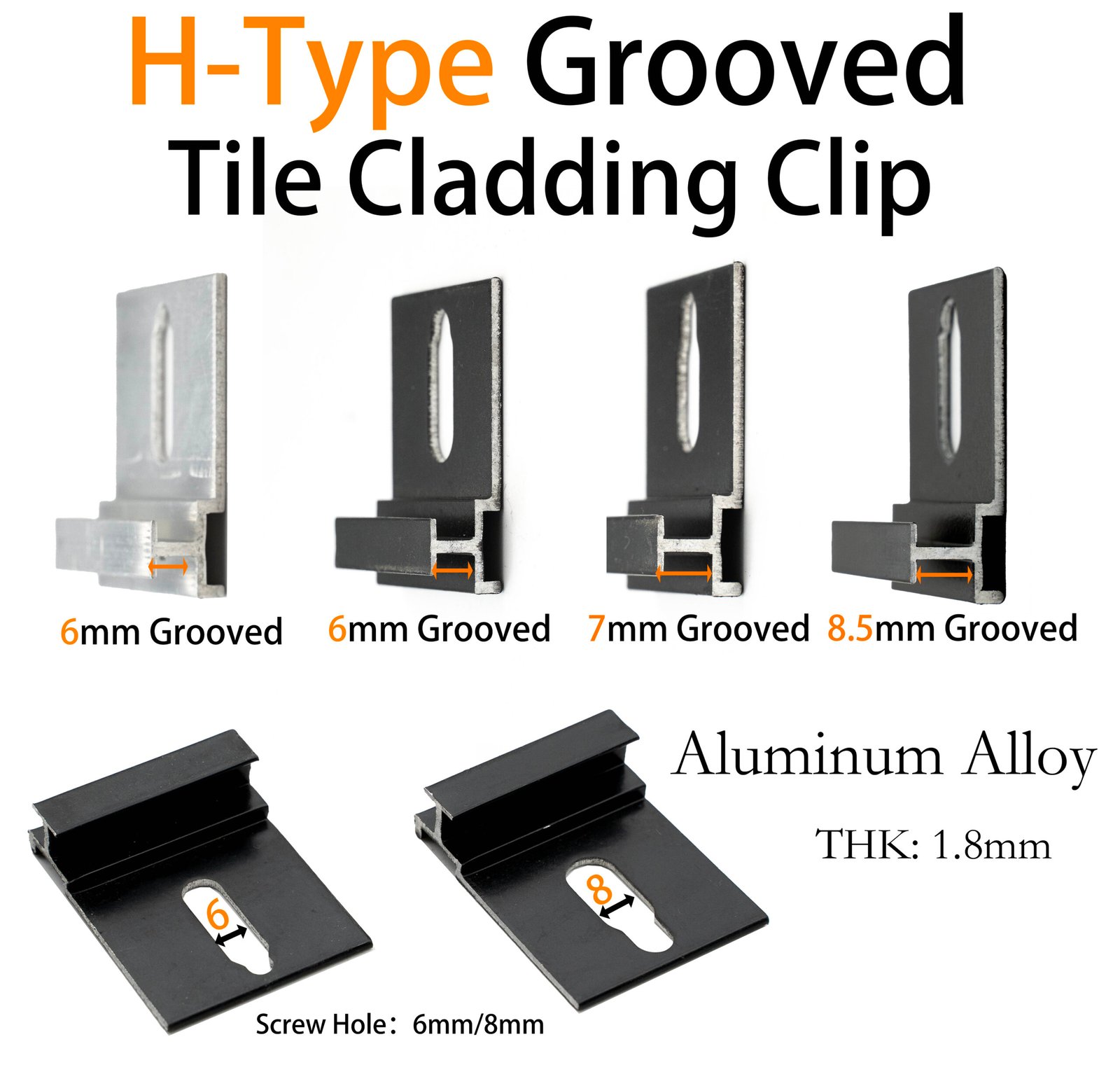
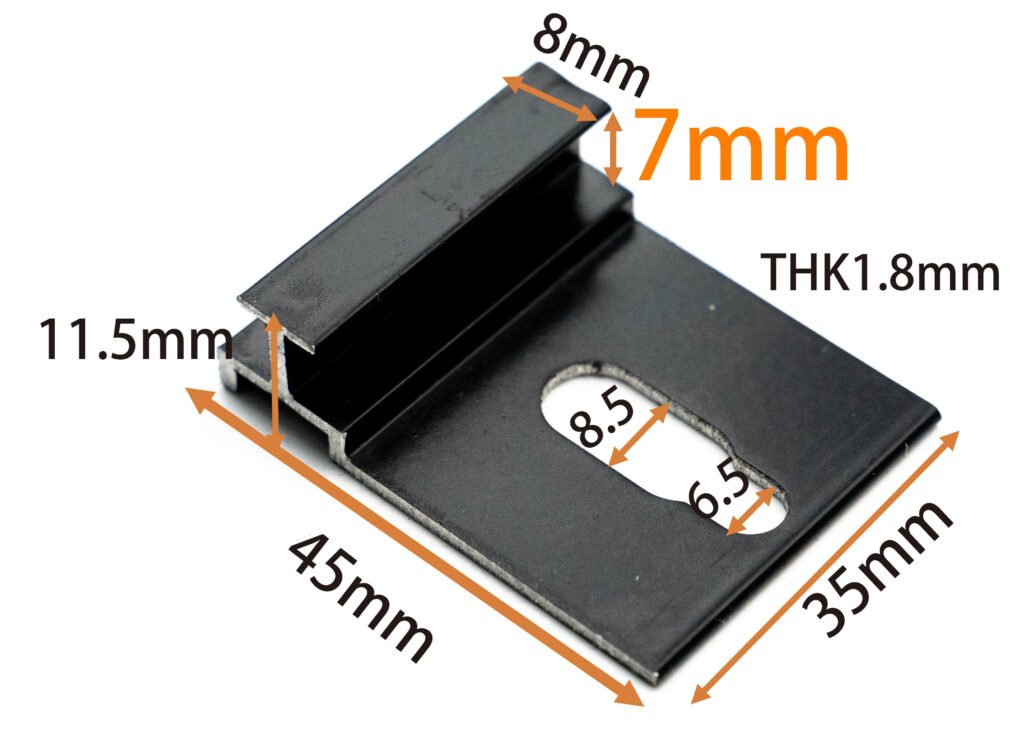
H-Type Grooved Tile Cladding Clip
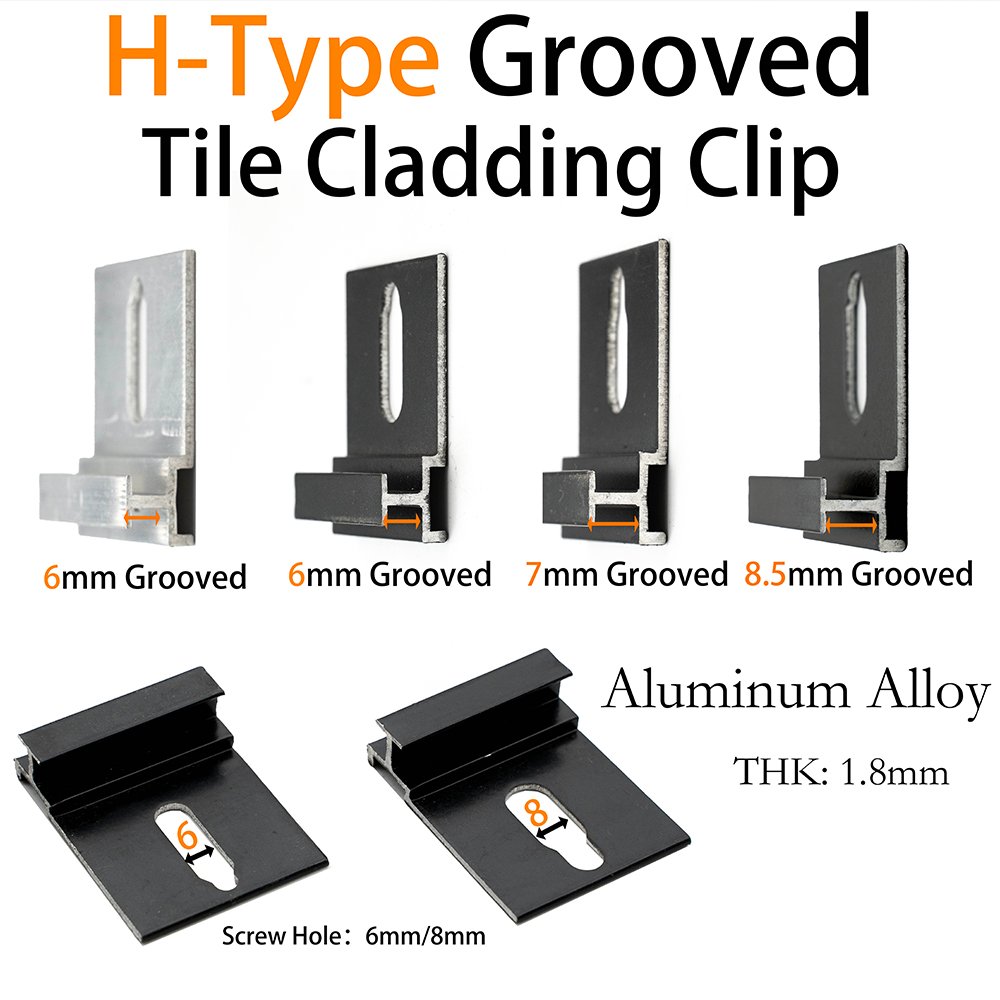
The H-Type Grooved Tile Cladding Clip is a concealed mechanical safety fixing designed specifically for exterior wall tiles with a recessed edge groove. Its H-shaped profile engages with the groove along the edge of the tile, providing additional mechanical restraint against panel detachment while the tile is installed using conventional adhesive or mortar.
Unlike general-purpose cladding clips, this system is designed to match a specific grooved-edge tile profile, allowing the clip to engage with the tile along its edges.
How the H-Type Cladding Clip Works
Many exterior wall tiles are manufactured with a recessed section along the outer edge of the tile. The outermost part of the tile is slightly thinner, creating an integrated edge groove.
The H-Type Cladding Clip is designed to fit into this recessed profile.
Because the tile groove is formed along the edges, the clip can engage with the top, bottom or side edges of the tile, depending on the installation position.
The clip is installed together with conventional tile adhesive or cement mortar. Its primary function is not to replace the adhesive fixing, but to provide an additional mechanical safety connection that helps restrain the tile against detachment.
Mechanical Edge Engagement
The key feature of the H-Type Cladding Clip is its mechanical engagement with the recessed tile edge.
The H-shaped channel grips the corresponding edge groove of the tile, creating a mechanical connection between the clip and the panel.
This is different from adhesive-dependent safety clips where the inserted tab mainly relies on epoxy adhesive to remain attached to a straight or angled groove.
The H-Type design can engage directly with the factory-formed edge profile, providing additional mechanical retention while allowing the tile to remain primarily adhesive-installed.
Designed for Grooved Exterior Wall Tiles
This clip is particularly suitable for exterior wall tiles manufactured with a recessed edge profile.
The system allows the clip to be used around different sides of the tile because the recessed profile can be present along multiple edges.
This makes it possible to adapt the fixing arrangement to different panel layouts and installation positions.
The exact groove profile should be confirmed before production to ensure the H-Type clip engages correctly with the tile edge.
Groove Size Options
To accommodate different tile manufacturers and panel profiles, we provide three standard groove configurations:
- 6 mm
- 7 mm
- 8.5 mm
The appropriate clip should be selected according to the actual recessed profile of the tile.
Because different manufacturers may use different edge dimensions, customized groove engagement dimensions can also be developed according to tile samples or technical drawings.
Material, Hole and Color Options
The H-Type Cladding Clip is available in black and white, allowing it to better match different joint and grout colors.
The standard clip thickness is:
- Main body: 1.7 mm
- Groove engagement section: 1.8 mm
Two fixing-hole options are available:
- 6 mm fixing hole
- 8 mm fixing hole
This allows the clip to be matched with different mechanical fasteners according to the installation system.
Adhesive and Mechanical Safety Fixing
The H-Type Cladding Clip is used as a secondary mechanical safety fixing.
The tile is normally installed using adhesive or cement mortar in the conventional manner, while the clip provides additional mechanical restraint between the tile and the supporting structure.
This combination allows the adhesive to perform the primary bonding function while the clip adds an additional layer of mechanical protection.
For exterior applications, the overall fixing system should be designed according to the panel dimensions, weight, substrate, environmental conditions and project requirements.
Key Features
- H-type mechanical edge engagement
- Designed for grooved exterior wall tiles
- Additional mechanical safety fixing
- Compatible with conventional tile adhesive or cement mortar
- Three groove options: 6 / 7 / 8.5 mm
- 1.7 mm main body thickness
- 1.8 mm groove engagement section
- 6 mm and 8 mm fixing-hole options
- Black and white color options
- Custom groove profiles available
Typical Applications
The H-Type Grooved Tile Cladding Clip is suitable for:
- Exterior ceramic wall tiles
- Grooved facade tiles
- Architectural tile cladding
- Exterior wall cladding systems
- Adhesive-installed tile facades requiring additional mechanical restraint
H-shaped panel holders are also used internationally in facade systems to mechanically engage the edges or folds of facade panels and transfer loads to the supporting substructure.
Request a Quote
All products are available in stock in various specifications, with custom production also available.